NBA Point Spread Explained: How Handicap Betting Works in the UK
 Available in US
Table of Contents
- What Is a Point Spread in NBA Betting?
- Reading NBA Spreads in Fractional and Decimal Odds
- What +4.5 and -4.5 Actually Mean
- Spread vs Moneyline: When Each Bet Makes Sense
- Key Numbers and Why They Matter in NBA Spreads
- Why NBA Spreads Move and How to React
- Alternative Spreads and Buying Points
- Spread Betting Strategy for UK Punters
- Frequently Asked Questions
I still remember the first NBA spread I ever placed. It was a Tuesday night, the Celtics were hosting the Pacers, and the line sat at -6.5. I backed Boston, they won by six, and I learned the hardest lesson in basketball wagering in the space of a single possession. That half-point gap between a win and a loss is the entire universe of spread betting — and once you understand it, you will never look at a basketball scoreline the same way again.
The point spread is the most popular single-game NBA market in the world. Basketball and American football between them account for roughly 35% of all sports betting handle in the United States, and the spread drives the bulk of that action. Here in the UK, handicap betting on basketball follows the same logic but wears different clothes — fractional odds instead of American, “handicap” instead of “spread” on some platforms, and a punter base that largely grew up on football’s Asian handicaps rather than the NBA’s point lines.
This guide breaks down every layer of NBA spread betting for a UK audience. I will walk you through the mechanics, show you how spreads translate into fractional and decimal formats, explain the numbers that actually matter, and share the strategic edges I have found over nine years of analysing NBA lines. Whether you are placing your first handicap bet on a Saturday night NBA slate or looking to sharpen an existing approach, the principles here will give you a concrete framework for reading, evaluating and acting on point spreads.
Try NBA margin of victory betting for an alternative to the spread.
What Is a Point Spread in NBA Betting?
A colleague once described the point spread as “a fictional head start that makes every game a coin flip.” That is not quite right — bookmakers are trying to balance their book, not achieve a perfect 50/50 split — but the intuition is useful. The spread exists to level the playing field between two teams of unequal ability, giving the weaker side a points cushion and forcing the stronger side to win by more than a specified margin.
Here is how it works in practice. Suppose the Golden State Warriors are playing the Charlotte Hornets. The bookmaker sets Golden State at -7.5 and Charlotte at +7.5. If you back the Warriors on the spread, they need to win by eight points or more for your bet to land. If you take the Hornets, Charlotte can lose by up to seven points and your bet still wins. A Hornets outright victory also counts, naturally.
The number 7.5 is not pulled from thin air. Oddsmakers build their lines using a blend of power ratings, recent form, injury reports, home-court data and historical head-to-head performance. The opening line typically appears 24 to 48 hours before tip-off, and it shifts as money flows in on either side. NBA fans who wager tend to be deeply engaged — they bet at 3.7 times the rate of the average sports bettor — which means the market receives a lot of sharp action quickly, and lines move fast.
One detail that trips up newcomers: the spread applies to the final score including overtime. If a game goes to OT and the extra period pushes the winning margin past the line, that counts. This is different from some football handicap markets where bets settle at 90 minutes. In NBA spread betting, every point scored in every period — regulation or otherwise — matters.
The spread is sometimes labelled “handicap” at UK-facing sportsbooks. The mechanic is identical. If you see “Charlotte Hornets +7.5 (handicap)” on a UK platform, it is the same bet as “Charlotte Hornets +7.5 (spread)” on an American one. The terminology shifts, but the maths does not.
Why is this market so dominant? Because it creates genuine two-sided action on games that would otherwise be unattractive on the moneyline. Nobody wants to back an overwhelming favourite at 1/8. A spread of -12.5 on that same favourite turns the bet into a genuine question: can they dominate by 13 or more? That tension is what makes spread betting the engine room of NBA wagering.
Reading NBA Spreads in Fractional and Decimal Odds
The first time I opened an NBA spread market on a UK sportsbook, I genuinely paused. The spread itself was familiar — Denver -5.5 — but the price next to it read 10/11 instead of the -110 I was used to seeing on American platforms. Same bet, same edge, completely different notation. If you have grown up reading football handicaps in fractional odds, the transition is painless. If you are coming from American resources, here is the translation layer you need.
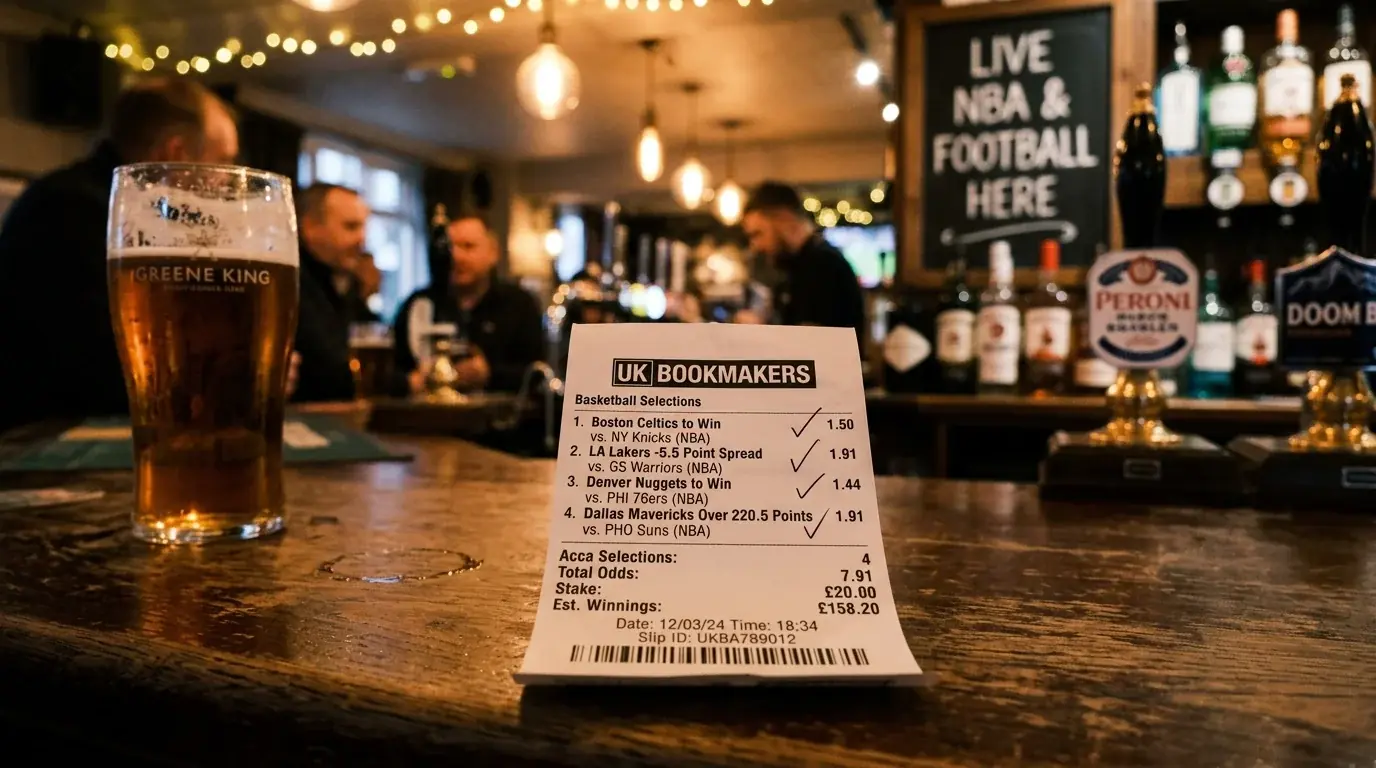
Most UK bookmakers price NBA spreads at or near even money — typically 10/11 or 5/6 on each side. That is because the spread itself is designed to split opinion roughly in half, so neither side deserves a big price. The 10/11 price means you stake 11 to win 10, returning 21 in total. In decimal odds, that is 1.91. In American odds, it is -110. All three expressions describe the same payout.
Some platforms default to decimal odds for basketball, even in the UK. This is partly because European and international customers prefer decimals, and partly because NBA markets attract a cross-border audience. You can usually toggle formats in your account settings, but it helps to be fluent in at least two. A spread priced at 5/6 in fractional is 1.83 in decimal. At 4/5, you are looking at 1.80 decimal. The small differences between 10/11, 5/6 and 4/5 represent shifts in the bookmaker’s confidence — or their exposure — on a particular side.
One thing to watch: some UK books present the spread with the price already adjusted, combining a different line with a different price. You might see Denver -4.5 at 5/6 alongside Denver -6.5 at evens (1/1). The spread number changes, and the odds compensate. Reading both numbers together — line and price — is essential. A “better” spread at a worse price can easily be the inferior bet. I will cover this in more detail in the section on alternative spreads below.
What +4.5 and -4.5 Actually Mean
Plus and minus signs carry the entire narrative of an NBA spread, and yet I have seen experienced punters confuse them at the worst possible moment. Let me make this as concrete as I can.
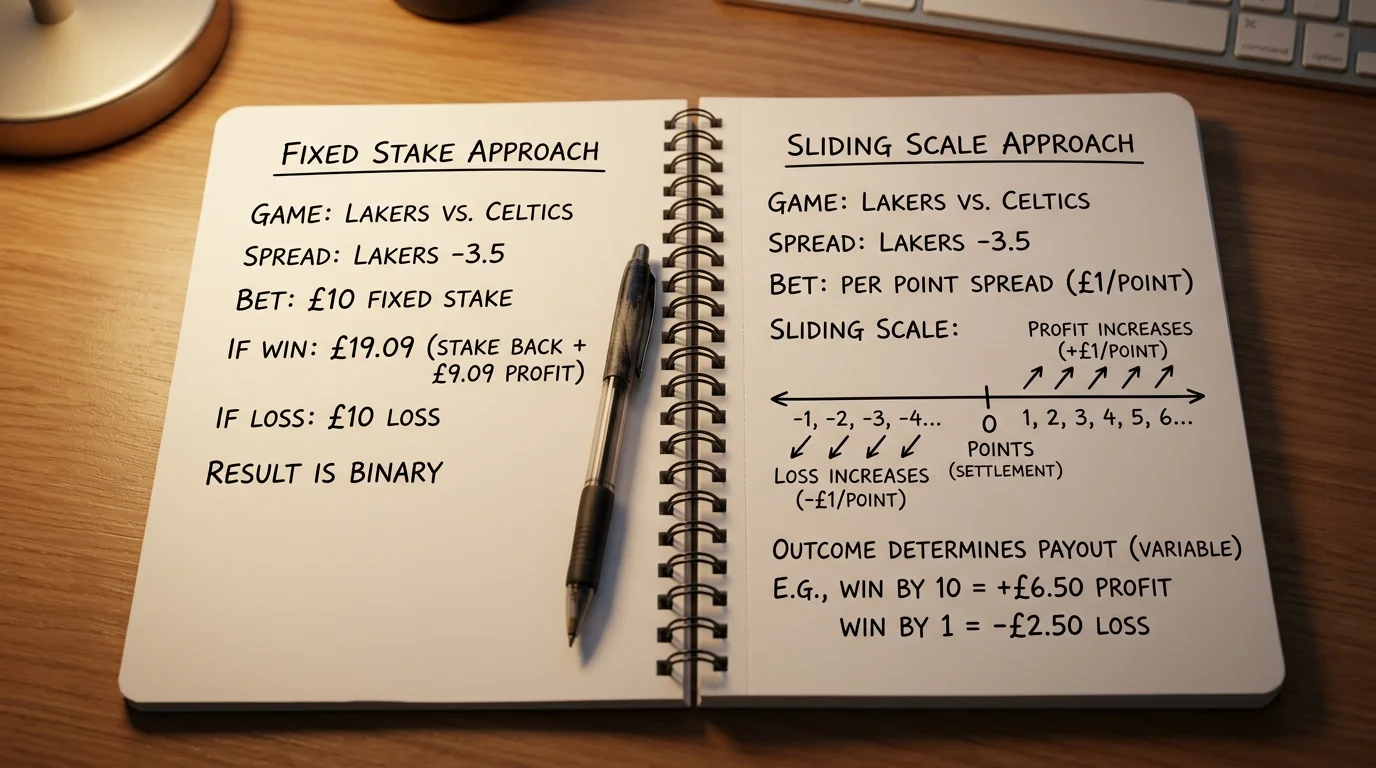
The minus sign (-) always belongs to the favourite. A line of -4.5 means the team is expected to win, and the bookmaker is asking them to cover a 4.5-point cushion. For your bet to win, they must finish with a final margin of victory of five points or greater. Think of it as a deduction from their score: after you subtract 4.5 from their total, do they still come out ahead?
The plus sign (+) belongs to the underdog. A line of +4.5 means the team receives a hypothetical 4.5-point boost. They can lose the game by up to four points and your bet still settles as a winner. If the actual scoreline is 108-105 against them, you add 4.5 to their 105, arriving at 109.5 versus 108 — bet wins.
Now, the half-point is not decorative. It exists to eliminate pushes — results where the margin lands exactly on the spread and the bookmaker has to refund every stake. NBA spreads at whole numbers (say, -4 rather than -4.5) do occur, and when they do, a push becomes a live possibility. If you back -4 and the favourite wins by exactly four, your stake is returned. No win, no loss. Half-point lines remove that ambiguity entirely, and you will find them on the majority of NBA games.
A practical example. The Bucks are -4.5 against the Hawks at 10/11. You place £20 on Milwaukee. Final score: Bucks 112, Hawks 106. The margin is six points, which clears the 4.5 threshold. Your bet wins, returning £38.18 (your £20 stake plus £18.18 profit at 10/11). If the Bucks had won 110-106 — a margin of four — your bet loses despite Milwaukee winning the game outright. That is the fundamental tension in spread betting: winning the game is not the same as covering the spread.
Understanding this distinction early saves real money. I have watched punters celebrate a favourite’s narrow win only to check their slip and realise the spread swallowed their stake. The scoreboard and the betting slip tell two different stories, and the spread is the reason why.
Spread vs Moneyline: When Each Bet Makes Sense
This is the question I get asked more than any other: “Should I take the spread or just back the moneyline?” The answer depends on one thing — how confident you are in the margin.
Moneyline is binary: pick the winner, collect. The problem is that NBA moneyline odds on heavy favourites are brutal. A team favoured by 10 points might be priced at 1/6 on the moneyline. You stake 60 to win 10. The spread on the same game — say, -10.5 at 10/11 — pays roughly even money but demands a larger winning margin. The moneyline is safer; the spread pays better. That trade-off is the whole conversation.
I lean towards the spread in three situations. First, when the favourite is heavily fancied and the moneyline price is compressed below 1/3. At those prices, the risk-reward ratio on a straight win bet is poor, and the spread gives you real returns for a bit more risk. Second, when I have a strong read on the game script — a team that dominates third quarters, an opponent that fades late, a pace mismatch that should produce a blowout. Third, when I am building accumulators. Spread selections at near-even money compound far more aggressively than short-priced moneylines.
The moneyline earns its place when the margin is uncertain but the outcome is not. NBA underdogs win outright roughly 35-40% of the time in a typical regular season, and when they do, the moneyline pays handsomely. If my analysis says a +6 underdog has a genuine chance of pulling off the upset — maybe they matchup well defensively, or the favourite is on the second night of a back-to-back — I would rather take the moneyline at 9/4 than the spread at 10/11. The payout for an outright win is far richer, and I do not need to sweat the margin.
NBA fans who engage with betting wager at 3.7 times the rate of the average American sports bettor, which tells you how much analytical energy the market absorbs. With that depth of engagement comes tight lines and efficient pricing. Both moneyline and spread are sharp markets, but the spread tends to offer more consistent value on favourites, while the moneyline rewards conviction on underdogs. Knowing which tool to reach for — and when — is a genuine edge.
Key Numbers and Why They Matter in NBA Spreads
In American football, the numbers 3 and 7 are sacred — field goals and touchdowns create natural clustering around those margins. Basketball has its own key numbers, though they are less dramatic and more evenly distributed. Understanding them is one of the quickest ways to sharpen your spread analysis.
NBA games most frequently land on final margins of 1 to 5 points. Data across recent seasons shows that margins of 3, 4 and 5 occur with slightly higher frequency than the surrounding numbers, partly because late-game fouling compresses or expands leads in predictable ways. A team trailing by five with 30 seconds left will foul, the opponent hits free throws, and the margin finishes at six or seven. A team trailing by two gets a stop, scores, and the game goes to overtime. These endgame dynamics create clusters.
The total NBA handle in the United States reached approximately 28 to 30 billion dollars in 2025, nearly matching the NFL, which means the spread market processes an enormous volume of informed money. That liquidity makes the lines efficient, but it does not eliminate the significance of key numbers. When a spread sits at exactly 5 or exactly 7, you are straddling a cluster point. Moving from -5 to -5.5, or from -7 to -7.5, crosses a threshold where a measurably higher percentage of games fall, and the price should reflect that.
As a practical matter, I pay close attention when a line moves through a key number. If the Suns open at -4.5 and drift to -5.5, that half-point hop across 5 is more significant than a move from -8.5 to -9.5, because more games settle on margins near five than near nine. The price attached to the spread should adjust accordingly — and when it does not, that is where opportunity lives.
Do not obsess over key numbers to the exclusion of everything else. They are one input in a wider model. But if two sides of a bet look roughly equal and the spread sits on a key number, that is often the detail that tips my decision.
See also: nba betting ods for all NBA handicap markets.
Why NBA Spreads Move and How to React
Last season I watched a line on the Lakers move from -3 to -5 in under two hours. No injury news, no roster announcement — just money. Sharp bettors had identified something the opening line missed, and the book adjusted. By the time the casual market woke up, the value was gone. Line movement is a conversation between the bookmaker and the betting public, and if you cannot read it, you are always arriving late.
NBA spreads move for three reasons: money, information and liability. Large wagers from respected accounts — what the industry calls “sharp money” — trigger the fastest adjustments. Bookmakers track which accounts have profitable histories and weight their bets more heavily than recreational stakes. When sharp money lands on one side, the line shifts even if the volume is modest. Public money, by contrast, tends to arrive later and in smaller individual amounts, but the sheer volume can also nudge lines, especially on nationally televised games featuring popular franchises.
Information-driven moves are more dramatic. A starting point guard entering the injury report, a late scratch confirmed on social media, a coach announcing a rest day for a star player — these events can swing a spread by two or three points within minutes. The best approach is to set up alerts for official NBA injury reports and team social media accounts. By the time an injury is mentioned on a broadcast, the line has already moved.
There is a popular strategy in spread betting circles that boils down to “sell high, buy low” — fading public enthusiasm on big-name teams when the market overreacts. Backing against the crowd on marquee clubs when the spread gets inflated by public money has historically produced a small but consistent edge. The logic is straightforward: casual punters overvalue name recognition and recent highlights, pushing the line beyond what the underlying matchup justifies.
My approach is simple. I form my own spread estimate before checking the market. If the book’s number is more than a point away from mine, I investigate why. Sometimes the book knows something I do not — an unreported injury, a travel situation I missed. Other times, the gap is driven by public sentiment, and that is where I act. Reacting to movement without understanding its cause is just chasing noise.
Alternative Spreads and Buying Points
Not every game fits neatly into the primary spread. That is where alternative lines come in — and they are more useful than most punters realise.
An alternative spread lets you move the line in either direction in exchange for adjusted odds. Take a game where the standard spread is -6.5 at 10/11. You can “buy” points by taking -4.5 instead, but the price drops to something like 4/6. Or you can “sell” points by taking -8.5, and the price stretches out to 6/5 or even 11/8. You are trading certainty for value, or value for certainty, depending on your read.
Buying points makes sense when the spread sits on or near a key number and you want to get to the safe side of it. If the line is -5 and you buy half a point to -4.5, you have crossed a cluster zone and your bet now survives a five-point margin that would have been a push. That half-point of insurance costs you some juice, but the probability shift is meaningful.
Selling points works in the opposite direction and suits games where you expect a blowout. If your analysis points to a dominant home performance — strong defensive matchup, opponent on a long road swing, key player returning from rest — selling two or three points off the spread can deliver a significantly better price without adding much practical risk. I use this approach selectively, maybe once or twice a week during the regular season, and only when my model’s projected margin exceeds the book’s spread by a wide margin.
A word of caution: alternative spreads carry wider bookmaker margins than the primary line. The overround on alt lines is typically higher, which means you need to be genuinely confident in your analysis to overcome the built-in house edge. Treat them as precision instruments, not default options.
Spread Betting Strategy for UK Punters
Strategy without structure is just gambling with extra steps. Over nine years of analysing NBA lines, I have boiled my spread process down to a handful of principles that consistently outperform intuition alone.
Build your own number first. Before checking any bookmaker, estimate what you think the spread should be. Use publicly available team ratings — offensive and defensive efficiency, net rating, pace — and adjust for home court, rest, travel and injuries. Your number will not be perfect, but it gives you a baseline. When your estimate disagrees with the market by more than 1.5 points, you have a potential play. When it agrees, you move on. This single habit eliminates a huge volume of impulsive bets.
Basketball is forecast to be the fastest-growing betting sport by compound annual growth rate through 2030, which means the market is getting sharper every season. Edges that existed three years ago are closing. The response is not to chase bigger edges but to be more disciplined about the ones that remain. Flat staking at 1-2% of your bankroll per spread bet keeps variance manageable across an 82-game season — and more importantly, it stops you from overreacting to a bad Tuesday night.
Schedule awareness is an underused edge in UK circles. Teams playing the second night of a back-to-back historically underperform their spread by a small but measurable margin. West Coast teams flying east for an early tip-off — those 17:30 GMT games that start at what feels like breakfast time in Los Angeles — show similar patterns. These are not guarantees, but they are systematic tendencies that compound over a full season. I keep a simple spreadsheet tracking rest days, travel distance and time-zone shifts, and it flags two or three spots per week worth investigating.
Finally, track everything. Record every spread bet you place: the line, the price, your projected spread, the result, the margin. After 100 bets you will have enough data to see where your model is strong and where it leaks. My own tracking showed that I was significantly better at evaluating spreads in games with a pace mismatch than in games between evenly matched teams — a finding I would never have uncovered without the log. For a deeper look at how overtime rules interact with spread settlement, that dedicated guide covers the edge cases.
Frequently Asked Questions
What happens to a spread bet if the margin equals the line exactly?
This is called a push. If you back a team at -6 and they win by exactly six points, your stake is returned in full — no profit, no loss. Half-point spreads like -6.5 exist specifically to prevent pushes. Most NBA spreads use half-points, but whole-number lines do appear, and you should be aware that a push is always a possibility when they do.
Do NBA point spreads include overtime scoring?
Yes. NBA spread bets settle on the final score including any overtime periods. If a game goes to overtime and the extra scoring changes the margin, that affects your bet. This is different from some football handicap markets that settle at 90 minutes. Every point in every period counts towards the spread.
Why are most NBA spreads set at half-points?
Half-point spreads eliminate the possibility of a push — a result where the margin lands exactly on the line and all bets are refunded. Bookmakers prefer decisive outcomes because pushes create administrative cost and tie up liability. Punters benefit too, since there is no ambiguity about whether you have won or lost.
Can I combine a spread bet with other selections in an accumulator?
Absolutely. NBA spread selections can be combined with moneylines, totals, player props and even bets from other sports in a standard accumulator. The spread selection at 10/11 or similar near-even-money prices compounds well across multiple legs. Just remember that each additional leg multiplies risk, so keep your accumulators focused and backed by analysis rather than optimism.
Created by the ”nba Betting ods” editorial team.