NBA Betting Odds
NBA Betting Odds: The Complete UK Punter’s Guide
 Available in US
Table of Contents
- Introduction
- The Numbers and Moves That Matter Most
- NBA Betting in the UK: Market Size and Growth
- How NBA Odds Work for UK Punters
- NBA Odds Converter & Value Calculator
- NBA Bet Types: What UK Bookmakers Offer
- NBA Season Calendar and When Odds Move
- Data-Driven NBA Betting Strategy
- UK Regulation, Licensing and Responsible Gambling
- Integrity, Scandals and What They Mean for Punters
- Frequently Asked Questions
By NBA Betting Analyst

Introduction
Nine years ago, I placed my first NBA bet through a UK bookmaker. The Celtics were hosting the Cavaliers, the fractional odds looked generous at 6/4, and I had absolutely no system beyond “I like this team.” I won that bet and lost the next seven. That stretch taught me more about basketball wagering than any winning run ever could — and it started a career spent dissecting NBA odds across UK and international markets.
The NBA betting market has grown into a $13.92 billion global force in 2026, and it is still accelerating. For UK punters, the opportunity is real but the landscape looks nothing like football. Games tip off late at night on our clocks. The odds formats on American-facing sites mean nothing without conversion. The sheer volume of markets — moneyline, spread, totals, player props, same game parlays, futures — can overwhelm anyone used to a simple 1X2 coupon.
Meanwhile, UK viewership of the NBA has surged 40% since 2019, with under-30s driving most of that growth. More eyeballs mean more betting interest, and UK-licensed bookmakers have responded by deepening their basketball coverage well beyond the playoffs. But deeper markets also mean more ways to lose money if you are navigating without a framework.
This guide is what I wish I had found before that losing streak. It covers every dimension of NBA betting odds that matters to someone placing wagers through a UK sportsbook: how fractional and decimal odds translate to implied probability, which bet types offer genuine edges, how the NBA season calendar creates predictable line movements, and what the UK regulatory environment means for your money. Every claim is backed by data, every strategy has been tested across seasons, and every section is written for punters who want to treat this seriously — not for tourists chasing accumulators.
Whether you are brand new to hoops betting or you have been wagering on NBA games for years and want to sharpen your approach, this is your reference point. Let’s get into it.
The Numbers and Moves That Matter Most
- The NBA betting market is projected at $13.92 billion in 2026, and UK viewership has grown 40% since 2019 — basketball wagering is no longer a niche pursuit for UK punters.
- Fractional odds remain the UK default, but learning to read decimal and American formats is essential for line shopping and consuming US-sourced analysis.
- Value betting — finding gaps between a bookmaker’s implied probability and your own estimate — is the foundation of every profitable NBA strategy.
- The NBA season calendar creates predictable edges: soft lines in October, schedule-based opportunities in March, and the tightest overrounds during the playoffs.
- Always verify Gambling Commission licensing before depositing, and use responsible gambling tools proactively — the late-night schedule makes discipline harder, not easier.
NBA Betting in the UK: Market Size and Growth
I remember when finding NBA odds at a UK bookmaker meant scrolling past three pages of football markets and hoping basketball was listed somewhere between darts and snooker. That was 2017. Today, basketball wagering is a global industry valued at $8.7 billion, and the NBA alone accounts for roughly 60% of that figure. The shift happened fast, and it happened because the audience changed.
$13.92bn
Projected NBA betting market value in 2026
£2.48bn
UK sports betting annual GGY as of early 2026
13.5m
Average monthly active online betting accounts in the UK
40%
Growth in UK NBA viewership since 2019

The global sports betting market hit $112.26 billion in 2025 and is projected to reach $325.71 billion by 2035. Basketball’s slice of that pie keeps getting larger. NBA fans wager 3.7 times more than the average sports bettor — a stat that tells you everything about how engaged this audience is. When someone follows the NBA closely enough to know rotation patterns and matchup data, they are far more likely to put money behind their analysis than a casual viewer.
In the UK specifically, the sports betting sector generates £2.48 billion in annual gross gaming yield. That is the revenue bookmakers keep after paying out winning bets, and it is growing year over year. The Gambling Commission reported 13.5 million average monthly active online accounts in Q4 2024-25, and those accounts are not just betting on the Premier League. Basketball has climbed to 13th place in overall UK sports engagement and — here is the number that matters — it ranks as the 6th most popular sport among 18-to-24-year-olds.
The Orlando Magic vs Memphis Grizzlies game at London’s O2 Arena drew over 18,000 fans and became the most-watched NBA Global Game ever held in the UK.
That demographic trend is the engine behind everything. Young UK punters grew up watching NBA highlights on social media, following player narratives, and consuming the league through a lens that football fans of previous generations never had. The under-30 audience is driving most of the viewership surge, and these are not passive fans. They follow player stats, they understand advanced metrics, and when a bookmaker puts up a line on a guard’s assists total, they have an opinion.
The practical consequence for you is straightforward: UK bookmakers are investing more in NBA coverage because the demand justifies it. Market depth has improved dramatically. Five years ago, you might have found moneyline and totals for a regular season game. Now, most major UK-licensed operators offer full spread lines, player props, quarter markets, and same game parlays for every fixture on the schedule. That depth creates opportunity — but only if you know where to look and what the numbers actually mean.
How NBA Odds Work for UK Punters
Here is a confession that might save you some early frustration: I spent my first six months betting on basketball without fully understanding the relationship between the odds on my screen and the probability they implied. I knew that 2/1 meant I would get two pounds for every one I staked, but I had no framework for deciding whether 2/1 was generous or stingy for a given matchup. That gap cost me money, and closing it was the single biggest improvement I ever made.
NBA Odds Converter & Value Calculator
Fractional on your UK slip, decimal for comparison, American on every US podcast – same price, three coats. Enter odds in any format with your own read, and see all three, the implied probability, and whether there’s genuine value.
How this works: all three formats express one probability in different coats. Fractional a/b becomes decimal (a ÷ b) + 1; decimal converts to American as (decimal − 1) × 100 for a plus price at 2.00 or longer, or −100 ÷ (decimal − 1) for a minus price below it. Implied probability – the chance baked into the price – is simply 1 ÷ decimal. Value is the whole game: it exists only where your own honest read of the probability sits above the implied figure, and the size of that gap is your edge. Expected value per £1 = (your probability × decimal odds) − 1 – positive means the price pays more than your read says it should. A word of discipline the maths enforces: convert first, compare to your estimate, and only back the price when your edge clears a few points with room to spare – a good team at a bad number is still a losing bet. Your probability is the one figure the calculator can’t check, so build it from form, rest, pace and matchup, not a feeling – and shop the same selection across UK books, because a better price lifts every number on this card. Not financial advice. 18+ – GamStop and BeGambleAware are protection routes; National Gambling Helpline 0808 8020 133.
NBA odds at UK bookmakers come in three formats, and you will encounter all of them if you spend enough time line shopping across sites. Fractional odds are the default at most UK sportsbooks. Decimal odds appear when you toggle your settings or use European-facing platforms. American odds show up constantly on US-sourced content — podcasts, tipster accounts, forums, data feeds — and you need to read them fluently even if you never use them on a betting slip.
Odds — a numerical expression of the likelihood of an outcome. In betting, odds determine both the implied probability of an event and the payout you receive if your bet wins.
Implied probability — the percentage chance of an outcome as expressed by the odds. If a team is priced at 1/1 (evens), the implied probability is 50%.
The critical thing to understand is that odds are not just payout multipliers. They are the bookmaker’s opinion about probability, adjusted by a margin that guarantees the house a profit over time. With 13.5 million active online betting accounts in the UK generating hundreds of millions of bets each month, bookmakers have enormous data sets to refine those opinions. Your job is to find the spots where their opinion is wrong — or at least less right than the price suggests. That starts with reading odds properly, and it starts below.
For a full deep-dive into all three formats with step-by-step conversion formulas, I have written a dedicated guide to fractional, decimal and American odds that covers every scenario you are likely to encounter.
Fractional Odds at a Glance
Fractional odds are the format most UK punters learn first, and for NBA betting they work exactly as they do for any other sport. The number on the left tells you the profit, the number on the right tells you the stake. At 5/2, you profit five pounds for every two you risk. Your total return is seven pounds — the five in profit plus your original two-pound stake back.
Where NBA fractional odds can look unfamiliar is in the size of the numbers. Football match odds tend to sit in neat ranges — 4/6, evens, 6/4. NBA moneyline odds on heavy favourites often stretch into territory like 1/5 or 1/7, which means you are staking five or seven pounds to win just one. Those short prices reflect the reality that NBA games rarely produce major upsets compared to football — a top-four seed losing at home to a bottom-five team is noteworthy precisely because it does not happen often.
| Scenario | Fractional | Decimal | American |
|---|---|---|---|
| Strong favourite | 1/4 | 1.25 | -400 |
| Slight favourite | 4/6 | 1.67 | -150 |
| Close to even | 10/11 | 1.91 | -110 |
| Moderate underdog | 6/4 | 2.50 | +150 |
| Big underdog | 7/1 | 8.00 | +700 |
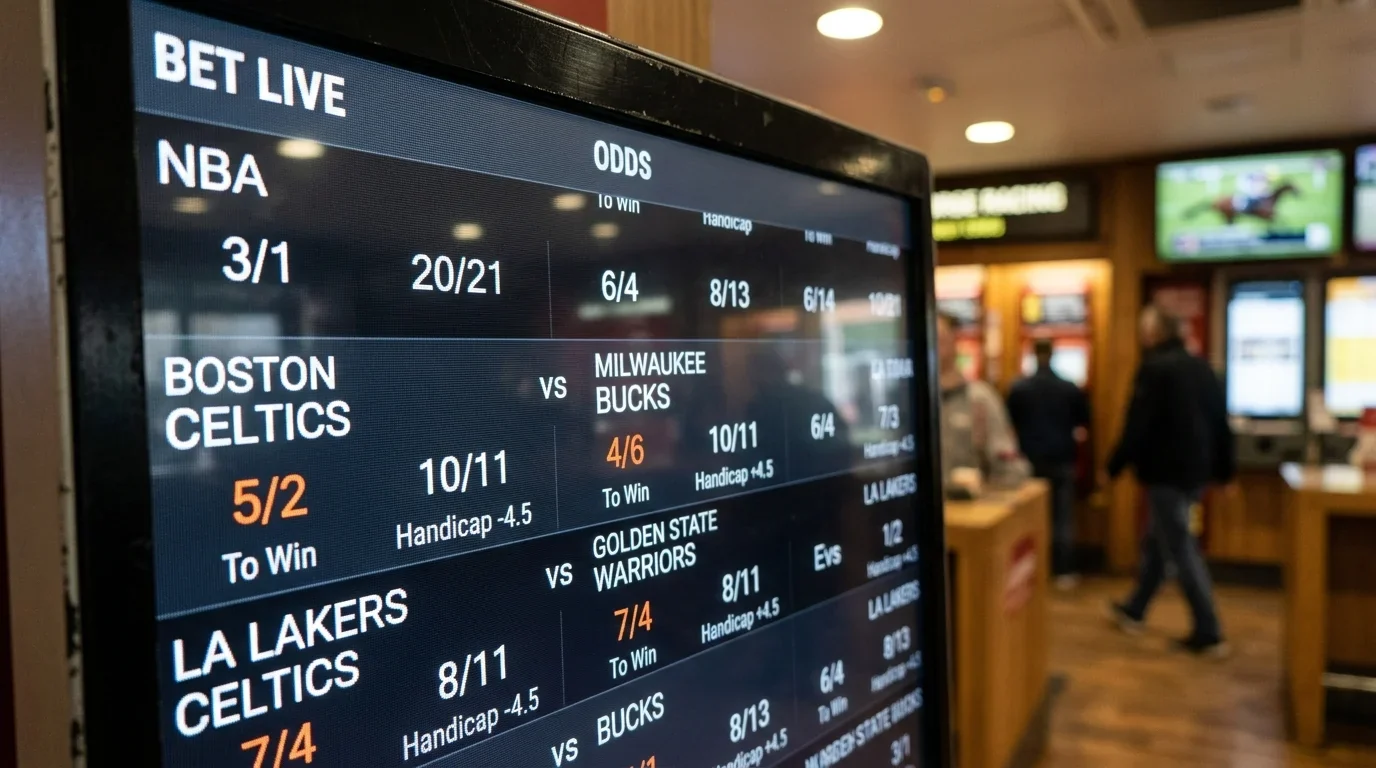
One thing worth noting: UK bookmakers sometimes display NBA fractional odds in slightly unfamiliar fractions like 10/11 or 5/6 rather than rounding to a clean number. This is actually useful information. Those awkward fractions often indicate that the bookmaker has priced the market tightly, which tends to happen for high-profile games and playoff matchups where the trading desk has more data and less room for error.
The calculation is always the same. Multiply your stake by the fraction to get your profit. Add the stake back to get total returns. If you see 11/8 on an NBA underdog and you stake ten pounds, your profit is ten multiplied by 11/8, which equals thirteen pounds and seventy-five pence. Total return: twenty-three pounds and seventy-five pence.
Decimal Odds at a Glance
Decimal odds are the format I actually prefer when I am comparing lines across multiple bookmakers, because the maths is instant. The number you see is your total return per pound staked, including the stake itself. At 2.50, a ten-pound bet returns twenty-five pounds. At 1.67, that same ten-pound bet returns sixteen pounds seventy. No fractions, no mental arithmetic — just multiply.
| Decimal Odds | Stake | Total Return | Profit |
|---|---|---|---|
| 1.25 | £10 | £12.50 | £2.50 |
| 1.91 | £10 | £19.10 | £9.10 |
| 3.40 | £10 | £34.00 | £24.00 |
Most UK sportsbooks let you toggle between fractional and decimal in your account settings. For NBA betting specifically, I recommend setting decimal as your default when you are doing any kind of odds comparison work. The reason is practical: when you are scanning four or five bookmakers to find the best price on a Lakers spread, comparing 1.95 vs 1.91 vs 1.87 is faster than comparing 19/20 vs 10/11 vs 87/100. Decimal odds also convert more cleanly to implied probability, which matters when you are trying to assess value — a concept I will come back to in the strategy section.
The conversion from fractional to decimal is simple: divide the fraction and add one. So 5/2 becomes 2.5 plus 1, which equals 3.50. Going the other way, subtract one from the decimal and convert to a fraction: 2.50 minus 1 equals 1.50, which is 3/2.
Implied Probability and the Overround
Odds become genuinely useful only when you translate them into probability. A price of 4/6 on a team winning sounds abstract until you realise it implies a 60% chance. If your own analysis suggests that team wins 70% of the time in this specific situation, you have found a value bet. If your analysis says 55%, you have found a trap. That gap between implied probability and your estimated true probability is where every profitable betting decision lives.
Converting odds to implied probability
Step 1: Take the fractional odds — say 5/4 on an NBA underdog.
Step 2: The formula is: denominator / (denominator + numerator) x 100.
Step 3: That gives us 4 / (4 + 5) x 100 = 44.4%.
Step 4: For decimal odds, the formula is even simpler: (1 / decimal odds) x 100. So 1 / 2.25 x 100 = 44.4%.
Step 5: The bookmaker is saying this team has a 44.4% chance of winning. If you think it is closer to 50%, the bet has value.
Here is where the overround enters the picture. In a perfectly fair market with two equally likely outcomes, both sides would be priced at evens (2.00 decimal). The implied probabilities would add up to exactly 100%. But bookmakers are running a business, so they compress the odds on both sides to build in a margin. A typical NBA moneyline might look like 1.87 on the favourite and 1.98 on the underdog. Converting both to implied probability gives you 53.5% plus 50.5%, which totals 104%. That extra 4% is the overround — the bookmaker’s built-in edge.
A lower overround means better value for punters. NBA markets at competitive UK bookmakers typically carry an overround between 103% and 106% on the moneyline, tightening to around 102-103% for high-profile games. Understanding this number is the first step toward comparing bookmakers on something more meaningful than brand recognition or promotional offers.
NBA Bet Types: What UK Bookmakers Offer
Walking into an NBA betting market for the first time feels a bit like opening a restaurant menu in a language you half-understand. There are familiar shapes — you can tell that thing is a main course — but the specifics need decoding. I have watched experienced football bettors freeze when they see a basketball coupon for the first time, not because the concepts are harder, but because there are more of them and they use different names.
The five core bet types below cover 90% of what you will encounter at any UK-licensed sportsbook. Each one represents a different way of expressing an opinion about an NBA game, and each carries different risk and reward profiles. Before I break them down individually, here is how they compare at a glance.
| Bet Type | What You Predict | Typical Odds Range | Best For |
|---|---|---|---|
| Moneyline | Which team wins | 1/5 to 7/1 | Strong opinions on the outright winner |
| Point Spread | Winning margin relative to a handicap | 10/11 to evens | Close games where the winner is predictable but the margin is not |
| Over/Under | Combined score above or below a set line | 10/11 to evens | When you have a read on pace and tempo |
| Player Props | Individual player statistics | 4/6 to 3/1+ | Deep knowledge of specific players and rotations |
| Futures | Season-long outcomes | 1/2 to 100/1+ | Long-range views on championship or MVP races |
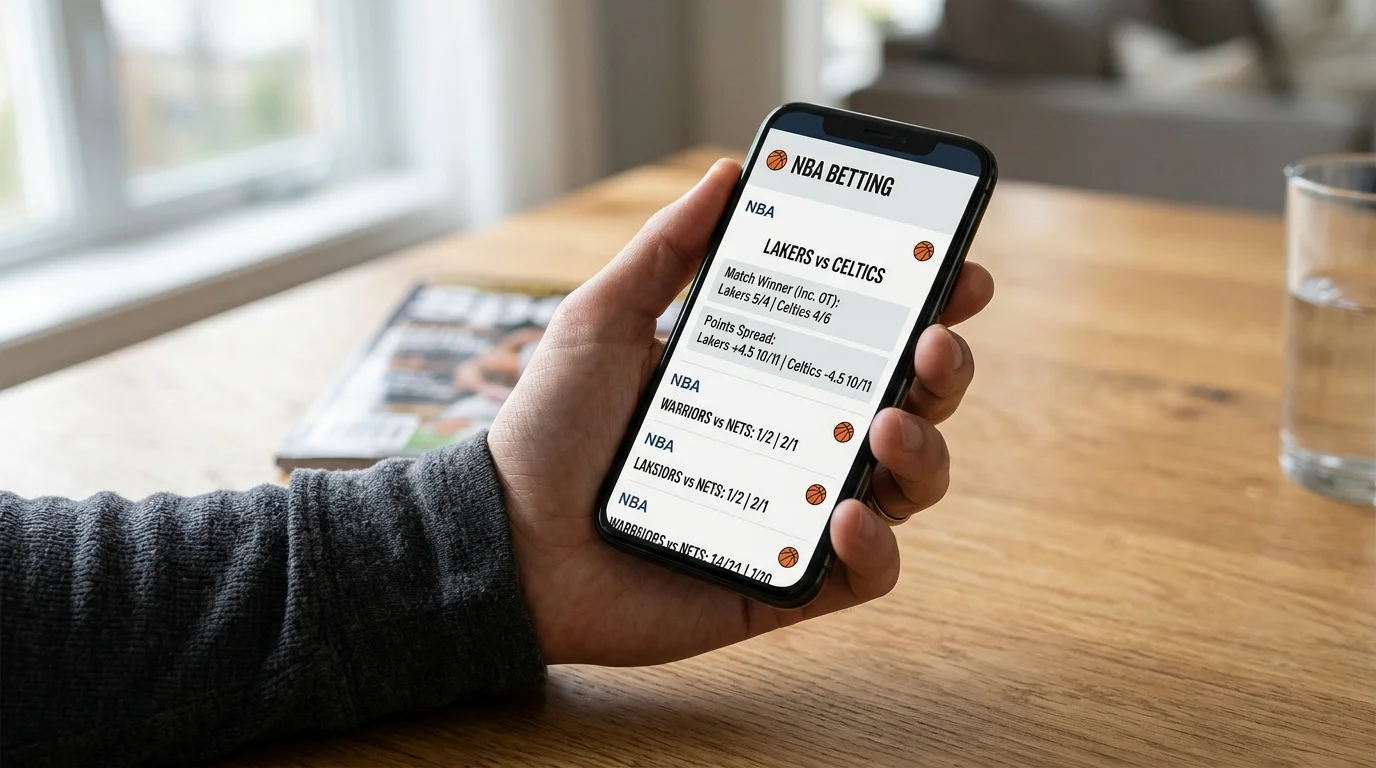
UK terminology note — what Americans call “moneyline” is labelled “match result” or “to win” at most UK bookmakers. “Point spread” is often listed as “handicap.” “Over/under” remains consistent across both markets. Do not let the naming differences throw you — the mechanics are identical.
Moneyline (Match Result)
The moneyline is the simplest bet in basketball: pick which team wins the game, full stop. No handicaps, no margins, no stat thresholds. If your team wins by one point in overtime or by thirty in a blowout, your bet pays the same.
| Matchup | Fractional | Decimal | American |
|---|---|---|---|
| Favourite (home) | 2/7 | 1.29 | -350 |
| Underdog (away) | 5/2 | 3.50 | +250 |
The challenge with NBA moneyline betting is that favourites win far more often than in football, which compresses the odds. Backing a heavy favourite at 1/5 means risking five pounds to profit one. Over a full season of 1,230 regular season games, those tiny returns erode quickly when a single upset wipes out multiple wins. Conversely, underdog moneylines can offer real value in the right situations — back-to-back games, West Coast road trips, late-season tanking scenarios. The key is knowing when the price adequately compensates for the risk, which I cover in detail in the point spread guide where I compare spread and moneyline side by side.
Point Spread (Handicap)
Point spread — a handicap applied to the favourite to level the playing field. A spread of -6.5 means the favourite must win by 7 or more points for a spread bet to pay out. The underdog at +6.5 can lose by up to 6 points and the bet still wins.
Spread betting is where most of the sharp action sits in NBA markets, and for good reason. Rather than asking “who wins?” the spread asks “by how much?” — and that second question is far harder for bookmakers to price perfectly. A team might be a near-certain winner but the margin could swing wildly depending on rotations, foul trouble, or a late-game garbage time run. That uncertainty creates exploitable gaps.
Suppose the spread is set at -4.5 on the home side. Both the favourite at -4.5 and the underdog at +4.5 will typically be priced around 10/11, creating a near-even proposition. The half-point eliminates the possibility of a push (a tie against the spread), which means every spread bet produces a winner and a loser. Most UK bookmakers list this under “handicap” in their basketball section. The underlying mechanic is identical to Asian handicap betting in football — same concept, different sport, different numbers.
Over/Under (Totals)
A totals bet ignores which team wins entirely. The bookmaker sets a line for the combined final score of both teams — say 224.5 — and you decide whether the actual total will finish over or under that number. Like spreads, the half-point eliminates pushes and both sides are usually priced around 10/11.
| Total Line | Over (Fractional) | Under (Fractional) |
|---|---|---|
| 224.5 points | 10/11 | 10/11 |
| 210.5 points | 5/6 | evens |
Totals betting rewards a different kind of analysis than moneyline or spread. Instead of evaluating which team is stronger, you are evaluating pace, defensive efficiency, rest situations, and matchup-specific tempo. A game between two top-five offences on fresh legs will play very differently than a mid-January clash between two defensive grinders on the second night of a back-to-back. The NBA’s scoring environment has trended upward in recent seasons, which means the average total line has climbed with it — but individual matchups still swing dramatically based on the specific teams involved.
One nuance that catches newcomers: overtime scoring counts toward the total in standard NBA bets. A game that is sitting at 210 combined points at the end of regulation might end up at 230 after a double-overtime finish, which can flip an under bet into a loss. Factor that into your analysis, particularly in tight games with high overtime probability.
Player Props — A Quick Look
Player props are bets on individual statistical performances rather than game outcomes. Common markets include points scored, rebounds, assists, three-pointers made, and combined stat lines. A bet on a guard to score over 24.5 points pays out regardless of whether his team wins or loses.
Props have exploded in popularity because they reward the kind of deep, player-specific knowledge that NBA fans naturally accumulate. If you follow a team closely enough to know that their starting centre averages 12 rebounds on two days’ rest but only 8.5 on back-to-backs, that is actionable information the bookmaker’s algorithm might not weight as heavily as you do. The same game parlay feature — letting you combine multiple prop selections within a single game into one bet — has made this market even more attractive, though it comes with correlated risk that needs careful management. I cover prop markets and strategy in full in the NBA player props guide.
Futures and Outrights — A Quick Look
Futures — also called outrights or ante-post bets in UK terminology — are wagers on outcomes that will be decided weeks or months from now. The most popular NBA futures markets are championship winner, conference winner, MVP, and season win totals.
Futures betting ties up your stake for a long time, which is the obvious drawback. The advantage is that prices move significantly over the course of a season, and early identification of a contender or an MVP candidate can lock in odds that look absurdly generous by March. Timing is everything in this market. A team that opens at 20/1 to win the title might shorten to 5/1 after a strong first half of the season — if you got on early, you are sitting on four times the value without placing another bet. The full breakdown of futures strategy, including when to hedge, lives in the NBA futures odds guide.
NBA Season Calendar and When Odds Move
One of my biggest early mistakes was treating NBA betting like a single continuous season. It is not. The NBA calendar has distinct phases, each with different dynamics, different market efficiencies, and different opportunities for UK punters who know where to look. Understanding this rhythm has shaped how I allocate my bankroll across the year more than any individual handicapping insight.
The NBA season runs from mid-October through to June, which means for UK-based bettors you are looking at roughly eight months of active wagering. Here is how the calendar breaks down and what it means for your odds.
Pre-season and opening week (October). Futures markets are at their widest. Championship odds, MVP odds, and season win totals are all available, and the bookmaker’s pricing reflects the highest uncertainty of the year. This is when early value is greatest — and when the most mistakes are made, because small sample sizes and offseason narratives dominate the conversation. Lines on individual games during the first two weeks tend to be softer than at any other point in the season.
Early regular season (November-December). The market starts to self-correct. Teams reveal their true identities — rotations settle, coaching adjustments become visible, and the data starts to become meaningful. Spread lines tighten. Futures prices begin their migration toward the eventual closing numbers. If you placed early futures bets, this is where you start to see whether your pre-season thesis is holding up.
UK time zone consideration — most NBA games tip off between 00:00 and 03:30 GMT. That timing matters for live betting, where you need to be awake and alert to exploit in-play odds movement. The late-night schedule is one reason why pre-game analysis and disciplined staking are even more important for UK punters than for their American counterparts.
All-Star break (February). A natural pause that splits the season. Futures markets re-calibrate around the trade deadline, which falls just before the break. A single blockbuster trade can shift championship odds by several points overnight. If you hold futures positions, this is a critical monitoring window.

Late regular season (March-April). This is where schedule-based edges peak. Teams locked into playoff positions rest starters. Teams chasing play-in spots push harder. Back-to-back games and long road trips take their toll on fatigued rosters. The line movement in this stretch can be dramatic and exploitable, because not every bookmaker adjusts quickly to rest patterns and lineup confirmations.
Playoffs (April-June). Everything changes. Seven-game series produce the most efficient lines of the year because the sample size within a series is small but the information density is enormous. Game-to-game adjustments by coaching staffs mean that a spread that was correct for Game 1 might be completely wrong by Game 4. Live betting volume surges during the postseason, with in-play markets offering some of the sharpest action of the year. The O2 Arena game that drew over 18,000 fans in London is a reminder that UK interest peaks during this stretch — and so does the quality of the markets.
NBA playoff games generate the tightest overround of the season at UK bookmakers — typically 102-103% on the moneyline, compared to 104-106% for mid-season regular season games.
Data-Driven NBA Betting Strategy
In my third year of NBA betting, I tracked every single wager I placed across the full season — 412 bets, documented with the odds, the reasoning, and the outcome. The results were humbling. My win rate on “gut feel” bets was 46%. My win rate on bets where I had a documented analytical edge was 54%. Eight percentage points might not sound like much, but across hundreds of bets at standard odds, it was the difference between a losing year and a profitable one. NBA Commissioner Adam Silver has spoken about the league’s evolving relationship with the betting industry, noting that the focus is on working with betting companies and putting additional controls in place to maintain the integrity of the game. That integrity matters to punters too — it means the data you are analysing reflects genuine competition, not manipulated outcomes.
NBA fans wager 3.7 times more than the average sports bettor, and that engagement cuts both ways. High volumes mean more liquid markets and better odds, but they also mean more competition. The person on the other side of your bet might be a sharp with a proprietary model, not a casual punter chasing a favourite. A systematic, data-driven approach is not optional if you want to be profitable — it is the entry requirement.
Do
- Track every bet with odds, stake, reasoning, and result
- Compare odds across at least three UK bookmakers before placing
- Focus on specific markets where you have a genuine informational edge
- Use implied probability to assess whether the price offers value
- Factor in schedule spots: back-to-backs, road trips, rest days
Don’t
- Chase losses by increasing stakes after a bad night
- Bet on every game — selectivity is your greatest asset
- Ignore line movement without understanding what caused it
- Assume that a team’s record alone determines their value as a bet
- Stack accumulators as your primary strategy — the maths work against you

Pre-bet checklist for NBA wagers
- Have I checked the injury report and confirmed the starting lineup?
- Is this the second night of a back-to-back for either team?
- Have I compared odds across at least three bookmakers?
- Does my implied probability estimate differ from the bookmaker’s by at least 3%?
- Is my stake within my pre-set unit size?
- Can I articulate my specific reason for this bet in one sentence?
Spotting Value in NBA Lines
Value betting is the entire game. It does not mean betting on underdogs and it does not mean finding the highest odds. It means finding bets where the implied probability is lower than your own assessment of the true probability. That is it. Everything else is noise.
Value calculation in practice
Step 1: A UK bookmaker prices an NBA team at 6/4 to win. The implied probability is 4 / (4 + 6) x 100 = 40%.
Step 2: Your analysis — based on recent form, rest advantage, and a favourable matchup — suggests this team wins 48% of the time in this specific situation.
Step 3: The gap is 8 percentage points. At 6/4, this is a clear value bet. Your expected value per pound staked is positive.
Step 4: If you had assessed the team’s true probability at 38%, the bet has no value despite the seemingly attractive odds. The price looks generous, but it is actually fair or even slightly short of what it should be.
The discipline here is doing this calculation before every bet, not after. I keep a simple spreadsheet where I log my own probability estimate alongside the bookmaker’s implied probability. Over the course of a season, the bets where I found a gap of 5% or more returned a positive ROI. The bets where I liked the team but could not identify a specific probability edge broke roughly even. The numbers do not lie — and they do not care about your hunches.
Where do those edges come from? In NBA betting, the most reliable sources of value are situational: rest advantages that the market underprices, lineup changes that are confirmed after the opening line is set, and pace mismatches that move the total but not the spread. None of these require a PhD in statistics. They require attention and consistency.
Bankroll Basics for NBA Wagering
The NBA regular season is 82 games per team, spread across six months, with up to 15 games on a single night. That volume creates a unique bankroll challenge: the temptation to bet constantly is enormous, and the margin for error on any single night is thin. I have seen disciplined bettors blow through a carefully managed bankroll in two weeks because the sheer frequency of NBA action overwhelmed their staking plan.
The one-percent rule — a widely used starting point for NBA bankroll management is to risk no more than 1-2% of your total bankroll on any single bet. If your bankroll is £500, that means individual stakes of £5 to £10. It sounds conservative, and it is. That conservatism is what keeps you solvent through inevitable losing streaks.
The core principle is straightforward: your unit size should be small enough that a ten-bet losing streak — which will happen at some point during an NBA season — does not materially damage your ability to continue betting. Flat staking (the same amount on every bet) is the simplest approach and the one I recommend for anyone who has not been tracking results for at least a full season. Percentage-based staking, where your unit adjusts with your bankroll, is more efficient but requires discipline that most people overestimate in themselves. This topic alone warrants its own deep treatment, which you will find in the full bankroll management guide.
UK Regulation, Licensing and Responsible Gambling
I once had a conversation with a fellow NBA bettor who had been using an unlicensed offshore sportsbook for years because the odds were marginally better. When a payout dispute arose over a four-figure futures bet, he had no recourse. No regulator to complain to, no dispute resolution process, no legal protection. The few pennies he saved per bet over the years were wiped out — and then some — by that single unresolved claim.
The UK has one of the most mature gambling regulatory frameworks in the world, and for NBA bettors that framework is a genuine asset, not a bureaucratic inconvenience. The Gambling Commission licenses and oversees every legal online bookmaker operating in the UK market. That oversight means your funds are held in segregated accounts, your disputes have a formal resolution pathway, and the operator is subject to ongoing compliance checks. The billions in annual gross gaming yield flowing through this regulated ecosystem depend on maintaining public trust — and the Commission enforces that trust with real consequences for non-compliance.
Licensing check — every UK-licensed bookmaker must display their Gambling Commission licence number on their website, typically in the footer. You can verify any licence directly on the Commission’s public register. If a site does not display a licence number, do not bet there. Full stop.
Adam Silver, the NBA Commissioner, has been consistent in his position that regulated markets are preferable to unregulated ones. His view — that bets are going to be placed regardless, and regulated markets are the better option — aligns directly with the UK’s approach. The Gambling Commission’s framework means that when you place an NBA bet through a licensed UK operator, you are operating in exactly the kind of regulated environment that the league itself advocates for.
Responsible gambling tools — every UK-licensed bookmaker is required to offer deposit limits, loss limits, session time reminders, cooling-off periods, and self-exclusion options. If you feel that your betting is becoming difficult to control, GamStop provides a free national self-exclusion scheme that blocks you from all UK-licensed online gambling sites for a period of your choosing. Use these tools proactively, not reactively.
One point that frequently confuses newcomers: betting winnings are not taxed in the UK. The tax burden falls on the bookmaker, not the punter. Whether you win ten pounds or ten thousand pounds on an NBA futures bet, you keep the full amount. This is a significant structural advantage over many other jurisdictions and one reason why the UK remains an attractive market for sports bettors.
Integrity, Scandals and What They Mean for Punters
No serious guide to NBA betting can ignore the integrity question, and I am not going to sanitise it. The NBA has faced real betting-related scandals in recent years, and those incidents have had direct consequences for the markets you and I bet into.
The integrity landscape — the NBA works with 17 authorised gaming operators and has invested heavily in integrity monitoring systems. Despite those safeguards, incidents involving player betting violations have prompted the league to reassess which prop markets should exist and how lower-profile players are monitored.
The league’s response has been substantive. Adam Silver has stated plainly that nothing is more important than the integrity of the competition, and the NBA’s actions have backed that up. The league has tightened its internal gambling policies, issued direct memos to all clubs emphasising the career-ending risks of gambling violations, and worked with betting partners to restrict certain prop markets — particularly those involving two-way players and end-of-bench roster spots where the financial incentive to manipulate is disproportionately high relative to the player’s salary.
For UK punters, the practical implications are twofold. First, certain niche prop markets that existed two or three years ago have been pulled or restricted. If you built a strategy around exotic props on low-usage players, that strategy may no longer be viable. Second, the increased focus on integrity monitoring means that the mainstream markets — moneyline, spread, totals, and props on established starters — are arguably more trustworthy than they have ever been. The NBA is actively collaborating with bookmakers to identify suspicious betting patterns, and that collaboration makes the markets you are betting into more reflective of genuine competition.
The broader regulatory conversation is also evolving. In the US, lawmakers have pushed for federal integrity standards that would harmonise the patchwork of state-level regulations. While that debate does not directly affect UK-licensed markets, it signals an industry-wide move toward tighter controls — which ultimately benefits anyone who wants to bet on clean outcomes.
With the market context, odds mechanics, bet types, strategy framework, and regulatory landscape covered, the questions below address the specific scenarios UK punters ask about most often.
Frequently Asked Questions
How do NBA betting odds work in the UK?
NBA odds at UK bookmakers work the same way as odds for any other sport. The bookmaker assigns a price to each possible outcome — a team winning, a total going over or under, a player hitting a stat threshold — and that price reflects the implied probability of the outcome plus the bookmaker’s margin. Most UK sportsbooks display NBA odds in fractional format by default (e.g. 5/2, 10/11), though you can toggle to decimal in your account settings. The odds determine both how likely the bookmaker thinks the outcome is and how much you stand to win. At 5/2, for example, a ten-pound stake returns thirty-five pounds total — twenty-five in profit plus your original ten. The key is understanding that odds are not just payout multipliers; they encode a probability estimate that you can compare against your own analysis to identify value.
What is the difference between fractional, decimal and American odds?
Fractional odds (e.g. 5/2) show profit relative to stake and are the UK default. Decimal odds (e.g. 3.50) show total return per unit staked, including the stake — they are popular across Europe and increasingly used by UK punters for comparison work because the maths is simpler. American odds use positive and negative numbers: +250 means you profit £250 from a £100 stake, while -150 means you need to stake £150 to profit £100. All three formats express the same underlying probability; the difference is purely presentational. You will encounter American odds constantly in NBA content from US sources, so being able to read all three fluently is a practical necessity for any UK punter following the league.
What types of bets can you place on NBA games?
UK bookmakers typically offer five core bet types for NBA: moneyline (which team wins outright), point spread or handicap (margin of victory relative to a set line), over/under or totals (combined score above or below a number), player props (individual player stats like points, rebounds or assists), and futures or outrights (long-term results like championship winner or MVP). Beyond these, most operators also offer quarter and half markets, same game parlays that combine multiple selections within one game, and a range of in-play markets that update in real time during the game. Market depth varies by operator and by the significance of the fixture — playoff games typically have the widest selection.
Does overtime count in NBA bets?
For most standard NBA bet types at UK bookmakers, overtime counts toward the final result. Moneyline bets, point spread bets, and game totals (over/under) all include overtime scoring in their settlement. The exception is period-specific bets — first quarter lines, first half bets, and some player prop markets are settled based on the relevant period only, not the full game including overtime. Always check your bookmaker’s specific settlement rules, as the wording can vary slightly between operators. The key practical point is that overtime adds volatility to totals and can swing a spread result, so factoring in the probability of a close game going to overtime is part of a thorough pre-bet analysis.
What are the best UK bookmakers for NBA betting?
Rather than recommending specific brands, I suggest evaluating UK bookmakers for NBA across five criteria: market depth (do they offer spreads, props, quarter lines, and same game parlays for every regular season game, not just marquee fixtures?), odds competitiveness (compare prices across at least three operators for the same game), live betting quality (speed of odds updates, range of in-play markets, and cash-out availability), mobile experience (since most NBA bets from UK punters are placed via phone, especially given the late-night schedule), and Gambling Commission licensing (non-negotiable — verify the licence number on the regulator’s public register). The operators who score well across all five tend to be the larger UK-licensed sportsbooks with established basketball trading desks.
How do I check if a UK bookmaker is licensed for NBA betting?
Every UK-licensed bookmaker must display their Gambling Commission licence number, usually in the website footer or in the “About” section. Copy that number and enter it into the Gambling Commission’s public register search tool, which is freely accessible. The register will confirm whether the licence is active, the specific activities it covers (remote betting, for instance), and whether any regulatory actions have been taken. If a sportsbook does not display a licence number, or if the number does not appear on the register, do not deposit money or place bets with that operator. This five-second check is the single most important thing you can do to protect your funds.
Can I bet on NBA games from the UK on any game night?
Yes. UK punters can legally bet on any NBA game through a Gambling Commission-licensed bookmaker, regardless of the night or time. The NBA regular season runs from mid-October to mid-April, with games scheduled nearly every day of the week. Playoffs extend from April through June. Pre-game odds are typically available 12 to 24 hours before tip-off for regular season games and often earlier for playoff fixtures. The practical challenge for UK bettors is timing: most NBA games start between midnight and 03:30 GMT, which means pre-game analysis often needs to happen in the evening before odds are fully mature. Live betting is available throughout the game, but the late hours mean you need to manage your alertness as carefully as your bankroll.
Created by the ”nba Betting ods” editorial team.