NBA Player Props: Markets, Strategy and Same Game Parlays
 Available in US

Three years ago, player props were an afterthought on UK sportsbooks — a handful of points lines buried below the moneyline and spread. Today they are the fastest-expanding segment of NBA wagering, and for good reason. Props shift the focus from the team to the individual, and in a league where 40% of adult Gen Z fans name a specific player as their favourite — the highest attachment rate across any major sport — that personal connection translates directly into betting interest.
The basketball betting market was valued at 8.7 billion dollars in 2024 and is on track to more than double by 2033, with player props driving a disproportionate share of that growth. For UK punters, this expansion means deeper markets, more competitive pricing and a wider range of statistical categories to wager on. It also means more traps, more correlation pitfalls and a steeper learning curve if you want to bet props profitably rather than recreationally.
I have spent the better part of nine years dissecting NBA lines, and props are where I find the most consistent mispricing. The bookmaker has to set hundreds of individual lines per game night, and the sheer volume creates soft spots that do not exist in the headline markets. This guide covers every prop category available at UK bookmakers, explains the mechanics of same game parlays, and lays out the data-driven approach I use to identify value. If you have ever wondered why a rebounds line felt “off” but were not sure how to act on that instinct, this is where we turn instinct into method.
Explore timing markets with NBA quarter and half betting options.
What Are NBA Player Props?
A player prop is a bet on an individual’s statistical performance rather than the game’s outcome. Will Jayson Tatum score over or under 27.5 points? Will Nikola Jokic grab more than 10.5 rebounds? Will Tyrese Haliburton dish out at least 9 assists? Each of these is a separate market, priced independently of who wins or loses.
The beauty of props is that they let you isolate what you know. Maybe you have no opinion on whether the Nuggets beat the Thunder, but you have a strong read on Jokic’s usage patterns against certain defensive schemes. Props let you trade on that specific insight without needing to predict the broader result.
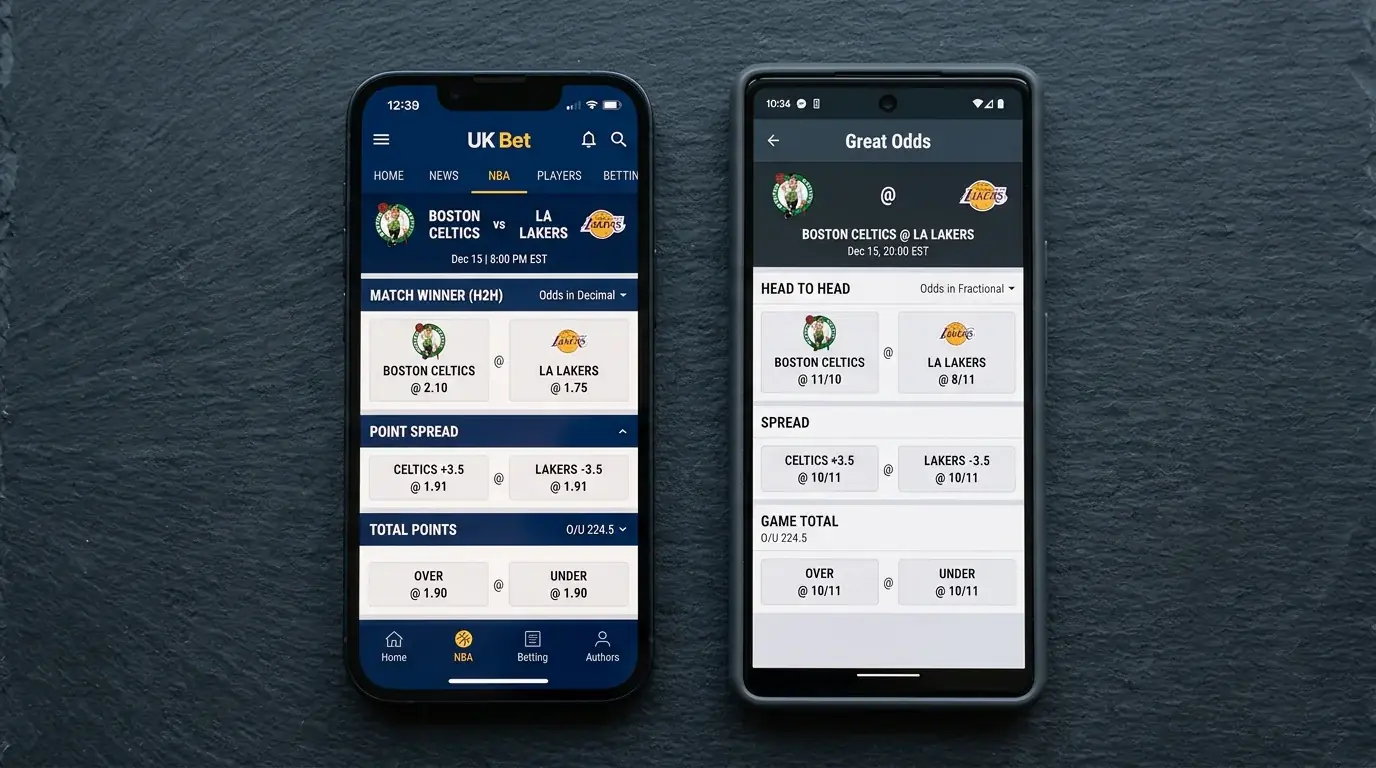
UK bookmakers typically present prop lines as over/under markets with a half-point to prevent pushes. Tatum over 27.5 points at 10/11, Tatum under 27.5 points at 10/11. Some platforms also offer “player to score 30+” or “player to record a double-double” as fixed-odds alternatives, which function more like outright bets than over/under lines. Both formats have their place, but the over/under structure is where the serious volume sits and where pricing is most competitive.
Prop markets open later than game lines — often 12 to 18 hours before tip-off — and they remain more volatile. A single piece of news — a teammate ruled out, a rotation change, an upgraded injury designation — can swing a prop line by two or three points. That volatility is a feature, not a bug. It creates windows of value that close quickly, rewarding punters who monitor injury reports and lineup confirmations in real time.
The scope of available props has expanded dramatically over the past three seasons. Where you once had points, rebounds and assists for starters only, you now find lines on minutes played, turnovers committed, personal fouls drawn and even specific shot types. UK sportsbooks have followed the American market’s lead here, largely because NBA viewership in the UK has grown 40% since 2019, and the audience skews young, data-literate and hungry for granular markets. The more stats a bettor can track, the more engagement the sportsbook captures — and the more opportunities exist for an informed punter to find mispriced lines.
Available Prop Markets at UK Bookmakers
Walk into any UK sportsbook’s NBA section on a game night and you will find somewhere between 50 and 200 individual prop markets per fixture. The range depends on the profile of the match — a primetime clash between contenders gets the full treatment, while a mid-week game between rebuilding teams might offer a more limited menu. Across all fixtures, though, the same core categories appear consistently, and understanding the full landscape of what the basketball betting market offers is the first step to finding edges within it.
Points Scored
Points scored is the flagship prop market — the deepest liquidity, the tightest margins, the most eyeballs. Every starter and most rotation players will have a points line posted. Star players typically get additional thresholds: Luka Doncic over 30.5, over 33.5, over 37.5, each at progressively longer odds.
The efficiency of this market means you need a genuine information edge to beat it consistently. Raw season averages are already priced in. What the bookmaker sometimes underweights are game-specific factors: opponent defensive rating against the player’s position, pace of the expected matchup, and minutes projections. A player averaging 24 points per game facing a top-five perimeter defence that forces contested mid-range shots is a different proposition than the same player facing a bottom-ten defence that leaks threes. Context is everything.
I track rolling five-game averages alongside season-long numbers, because NBA players go through hot and cold stretches that can persist for a week or more. When a player’s recent output diverges meaningfully from his season average, the prop line often lags behind the trend by a game or two. That lag is small, but it is real, and it is where I find the most consistent edge in points props.
Rebounds, Assists and Combined Stats
Rebounds and assists props are where I find the softest lines on a regular basis. Points are the stat everyone watches, so the market prices them efficiently. Rebounds? Assists? Fewer eyeballs, more room for error in the line-setting process.
Rebound props are heavily influenced by pace and shot distribution. A big man’s rebound total rises when his team or the opponent takes more mid-range and three-point shots, because long rebounds create more contested opportunities. Against a team that lives at the rim, those opportunities shrink. The bookmaker accounts for some of this, but not always precisely enough. Assists are even more context-dependent — a point guard’s assist line should flex based on whether his primary scoring options are available, whether the opponent plays a switching defence that limits drive-and-kick opportunities, and whether the game script is likely to produce blowout minutes or competitive crunch time.
Combined stat markets — points + rebounds, points + assists, points + rebounds + assists — add another layer. These “combo” props are popular with recreational bettors because the numbers are larger and the lines feel more forgiving. In practice, the bookmaker applies a wider margin on combos, and the correlation between the component stats is not always priced accurately. A player who scores heavily might do so at the expense of assists if the team’s offence runs through isolation plays. That negative correlation can make a points + assists over line harder to hit than it appears.
Specialist Props: Threes, Steals, Blocks
Three-pointers made, steals, blocks and turnovers round out the specialist prop menu. These are lower-volume, higher-variance markets, and they attract a mix of sharp action and uninformed recreational bets.
Three-pointers made is the most tradable of the group. High-volume shooters have reasonably predictable distributions — a player who averages 3.2 threes per game on eight attempts will clear an over 2.5 line at a reliable clip, and the price reflects that. The edge appears when shot volume shifts due to lineup changes or defensive strategy. If a team’s secondary ball-handler is ruled out and the primary shooter is likely to absorb extra possessions, the threes line may not adjust quickly enough.
Steals and blocks are inherently volatile. Even elite defenders post zero steals or zero blocks in a significant percentage of games. The lines here are typically set at 0.5 or 1.5, and the juice is heavy. I rarely bet these markets outright, but I include them selectively in same game parlays when the matchup profile supports a strong defensive performance — a shot-blocking centre facing a team that attacks the rim aggressively, for instance.
Same Game Parlays: Building Multi-Leg Props
Same game parlays have become the showpiece product of modern NBA betting. Every major UK bookmaker now offers them, and the uptake has been extraordinary — SGPs let you combine multiple prop selections from a single game into one accumulator-style bet with a single combined price. Points over, rebounds over, team to win: all on one slip.
The appeal is obvious. NBA fans who bet do so at 3.7 times the rate of the average American sports bettor, and SGPs feed that engagement by turning a single Tuesday night game into a multi-layered narrative. Will Jokic drop a triple-double AND the Nuggets win by 10? The payout is juicy, and the drama stretches across every quarter.
The catch — and there is always a catch — is correlation. Same game parlay engines calculate prices using correlation matrices that estimate how one outcome affects another. If you combine “Team A wins” with “Team A’s star scores over 30.5,” those outcomes are positively correlated: the star scoring big makes a team win more likely, and vice versa. The bookmaker’s model accounts for this and reduces the combined price accordingly. But these correlation adjustments are imperfect. They tend to be conservative in some spots and generous in others, depending on the sophistication of the underlying model.
Where I find the most SGP value is in combinations that the correlation engine underprices. Negative correlations — where one outcome makes another less likely — are harder for models to handle. A blowout win for Team A probably means their star rests in the fourth quarter, capping his points total. Combining “Team A -12.5” with “Star player over 32.5 points” is a structurally difficult parlay because the blowout reduces the star’s minutes. If the SGP engine does not fully discount that tension, the combined price may look attractive but the actual probability is lower than advertised.
My rule for SGPs: never build one for entertainment value alone. Every leg should be individually justifiable. If you would not bet each component as a standalone prop, do not bundle them. The accumulator structure amplifies the bookmaker’s edge with each leg you add, and undisciplined SGPs are a reliable way to donate money to sportsbooks.
A practical approach that has worked for me: limit SGPs to two or three legs and focus on combinations where the correlation is either negligible or working in your favour. Player rebounds over in a game you expect to be high-scoring, for instance — more possessions mean more shot attempts, which means more missed shots and more rebound opportunities. That positive correlation is structural, and the SGP engine does not always price it aggressively enough. Conversely, avoid pairing a player’s points over with the opposing team winning, because a blowout loss often means garbage time minutes for bench players while the star sits. Three disciplined legs with genuine analytical backing will outperform six speculative legs every time.
Data-Driven Prop Betting Strategy
Live in-game betting is growing at 12% annually in adoption, and a significant chunk of that growth is driven by live player props. But the most profitable prop betting still happens before tip-off, when you have time to research and the market has not yet absorbed the full picture.
My prop workflow starts with minutes projection. Nothing matters more than how long a player is on the court. A starter averaging 34 minutes per game who is projected to play 28 due to a blowout game script or a minor niggle will underperform his prop lines across the board. I check injury reports, recent minutes trends, and the expected competitiveness of the game before touching a single line.
Next, I look at opponent defensive matchups by position. Most free stat databases let you filter defensive efficiency by position group. If a team allows the third-most points to opposing point guards but ranks in the top five against centres, that asymmetry tells me which props are worth investigating and which are likely priced accurately.
Pace is the third pillar. Two teams that both play at a top-ten pace will produce more possessions, more shots, more rebounds and more assists than two defensive-minded teams grinding through the shot clock. Prop lines are set relative to a player’s season average, but pace context varies game to game. A player averaging 22 points in a neutral pace environment might be worth an over in a projected track meet — and an under in a defensive slog. NBA Commissioner Adam Silver has acknowledged the league’s ongoing efforts to work with betting companies on additional controls, which underscores how seriously the prop market is taken at the institutional level.
Finally, I keep a simple tracking sheet. Every prop bet I place gets logged with the line, the price, my projected number and the result. Over a season, the patterns become visible. Last year I discovered I was significantly more accurate on assists props than points props, which led me to concentrate more of my prop volume on assists and back away from a market where my edge was thinner. That kind of self-awareness only comes from data, not from memory.
See also: nba betting ods for all NBA prop markets.
Common Mistakes and Integrity Concerns
The Jontay Porter case in 2024 sent shockwaves through the NBA betting world and put player props squarely in the integrity spotlight. Porter, a fringe rotation player, withdrew early from games after allegedly collaborating with bettors who had wagered on his stat unders. The NBA handed down a lifetime ban, and the fallout reshaped how the league thinks about prop markets.
Adam Silver responded by asking some of the NBA’s authorised betting partners to pull back certain prop bet categories, particularly on two-way players and end-of-bench personnel whose statistical output is easier to manipulate. The logic makes sense: a star’s 28-point average is hard to artificially suppress, but a fringe player’s 4-rebound average is far more vulnerable. For UK punters, this means some niche prop markets may be thinner or unavailable on certain players, and it is worth understanding why.
Beyond integrity, the most common prop mistake I see is anchoring to season averages without accounting for context. A player’s 21-point average includes games against the best and worst defences in the league, home and away, fresh and fatigued. Treating it as a fixed number rather than a distribution is a recipe for inaccuracy. The second most common mistake is overloading same game parlays with correlated legs and assuming the correlation works in your favour. It often does not.
A subtler trap is prop shopping failure. The same player’s points line can vary by a full point across different UK sportsbooks — 24.5 at one, 25.5 at another. That single point represents a meaningful probability shift, and taking the worse number out of habit or loyalty is leaving money on the table. Over a full NBA season, those single-point differences compound. If you are placing 200 prop bets across the year — a modest volume for a serious bettor — consistently taking the better line translates to a measurable improvement in your overall return. For a deeper look at the analytics behind prop evaluation, the advanced stats for betting guide covers the metrics that matter most.
One final note on discipline. Props feel smaller and less consequential than a spread or moneyline bet, and that perception is dangerous. I have watched punters who would never stake £20 on a careless spread bet happily scatter five-pound prop bets across a dozen markets without a single minute of research. The total exposure adds up, and the cumulative bookmaker margin on poorly chosen props is brutal. Treat every prop with the same analytical rigour you would apply to a headline market. The numbers are smaller per bet, but the edge — or the lack of one — compounds identically.
Frequently Asked Questions
What is a same game parlay in NBA betting?
A same game parlay combines multiple selections from a single NBA game into one bet. You might combine a team to win, a player to score over a certain number of points, and the game total to go over — all on one slip. The selections are priced together using a correlation model that adjusts the combined odds based on how the outcomes relate to each other.
Which NBA player stats are most predictable for prop bets?
Points scored is the most stable stat for high-usage players, but assists tend to have the lowest variance relative to their mean for elite playmakers. Rebounds fall somewhere in between. Specialist stats like steals and blocks are highly volatile and harder to predict consistently. The best approach is to focus on whichever stat category you can model most accurately given the matchup context.
Do UK bookmakers offer first-basket-scorer markets?
Yes, most major UK sportsbooks offer first-basket-scorer props on NBA games. These are high-variance bets with long odds — typically ranging from 4/1 to 12/1 depending on the player. They settle based on who scores the first field goal of the game, excluding free throws. Centres and players who contest the opening tip tend to offer slightly better structural value in this market.
How does rest and rotation affect NBA player prop lines?
Rest and rotation have a direct impact on prop lines. When a teammate is ruled out, the remaining players absorb extra minutes and usage, which pushes their prop lines upward. Load management and back-to-back rest days can remove key players entirely, restructuring the entire prop slate for that game. Monitoring injury reports and official lineup confirmations in the hours before tip-off is essential for spotting mispriced props.
Written by the editors at nba Betting ods.