NBA Moneyline Betting: How Match Result Odds Work
 Available in US

Every complex NBA bet I have ever placed started life as a moneyline. Before I understood spreads, before I could explain implied probability, before I even knew what a same game parlay was, I knew this much: pick the team that wins and collect your money. That simplicity is what makes the moneyline the most popular entry point for NBA bettors — and it is also what tricks people into thinking there is nothing more to it. Basketball (including the NBA and college leagues) is the most-bet sport in the United States, accounting for roughly 35% of total handle, and the moneyline is where the bulk of that action starts.
Compare moneyline with NBA point spread to choose the right market.
How NBA Moneyline Bets Work
Last season I watched a friend stare at a betslip showing Denver Nuggets 2/5 and Orlando Magic 9/4 for a full two minutes before asking me: “So if I put a fiver on Denver and they win, I get two pounds?” Close — but not quite. Let me clear this up properly.
A moneyline bet is a wager on which team wins the game outright. No margin matters, no point total matters — just the result. In the UK, you will most often see these odds presented in fractional format. At 2/5, a winning 5-pound stake returns 2 pounds of profit plus your 5-pound stake back, giving you 7 pounds total. At 9/4, a winning 4-pound stake returns 9 pounds profit plus your 4-pound stake, giving you 13 pounds total.
The fraction tells you the ratio of profit to stake. The smaller the fraction (relative to 1/1), the heavier the favourite. At 1/8, you would need to risk 8 pounds to profit just 1 pound — a steep price that reflects the bookmaker’s assessment that this team is overwhelmingly likely to win. At 3/1, a 1-pound stake returns 3 pounds profit, signalling a significant underdog.
One detail that catches newcomers: NBA moneyline bets include overtime. If the game is tied after four quarters and goes to an extra period, your bet rides on the final result including OT. There is no “regulation time only” option on a standard moneyline. The team must win the game, however long it takes.
Betting Favourites vs Underdogs on the Moneyline
Here is a pattern I noticed in my own records after three years of tracking: I was profitable on underdogs and losing money on favourites, despite the favourites winning more often. The reason was pure maths. NBA fans bet on the NBA at 3.7 times the rate of the average American sports bettor — that intensity means popular teams attract disproportionate money, which shortens their odds and erodes value.
Backing a heavy favourite at 1/5 means you need that team to win 83% of the time just to break even. In the NBA, even elite teams rarely win at that clip across a full season. The 2015-16 Warriors, the best regular-season team in history at 73-9, won 89% of their games — but that is a historic outlier. Most championship contenders hover between 65% and 75%. When the odds imply a win probability above the team’s actual rate, you are overpaying.
Underdogs, by contrast, are often underpriced because casual bettors avoid them. A team at 5/2 is implied to win about 29% of the time. If your analysis suggests they win 33%, that gap is where profit lives. Over 100 bets, that 4-percentage-point edge translates into meaningful returns — but only if you have the stomach to lose roughly two out of every three wagers. That emotional challenge is why most punters gravitate toward favourites despite the worse maths.
The practical takeaway: do not assume that the better team is the better bet. The odds already reflect their superiority. The question is whether they reflect it accurately.
Moneyline in Context: How It Compares to Other NBA Bet Types
I once had a conversation with a fellow bettor who insisted the moneyline was “for beginners” and that real NBA betting meant spreads and props. He is wrong, and his P&L over the last two seasons confirms it. The moneyline is not simple in the sense of being easy to beat — it is simple in the sense of being easy to understand. Those are very different things.
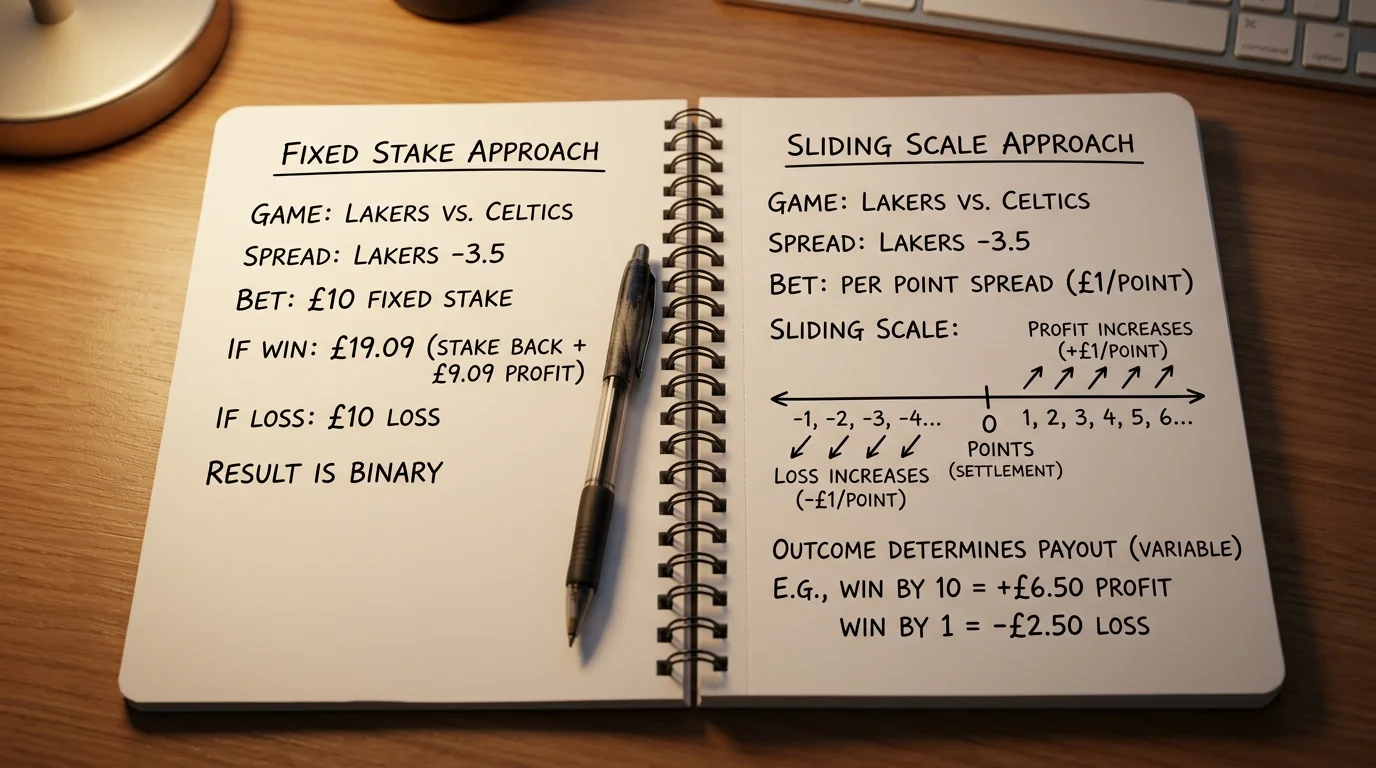
Compared to the point spread, the moneyline removes margin from the equation. With a spread bet, you need your team to win by more than a set number of points (or lose by fewer). The moneyline strips that away: win by 1 or win by 30, the payout is the same. This makes the moneyline a cleaner expression of belief — you think a team wins, full stop. The tradeoff is odds. Spread bets on both sides are typically priced near even money (10/11 is standard), while moneyline odds on the favourite can be severely compressed.
Compared to totals (over/under on combined points), the moneyline ignores scoring volume entirely. You do not care whether the game finishes 118-112 or 89-84, as long as your team is on the right side. This makes moneyline bets simpler to analyse — you need a view on who wins, not on how the game flows — but it also means you are ignoring a rich source of information that totals bettors exploit.
Compared to player props, the moneyline is team-level analysis rather than individual-level. You do not need to know how many assists a specific point guard will dish out. You need the bigger picture: is this team, on this night, against this opponent, going to win? That macro focus is why moneyline bets remain the backbone of many successful NBA bettors’ approaches, even at the highest level of sophistication.
Visit nba betting ods for NBA moneyline resources.
Moneyline Accumulators: Stacking NBA Match Results
The appeal is obvious. String together four moneyline favourites at 2/5, 1/3, 4/9 and 1/4, and the combined odds look attractive despite each leg being short-priced individually. This is how most UK punters build their NBA accumulators, and it is also how most of them lose.
The maths is unforgiving. Each leg multiplies not just the potential return but also the probability of failure. Four favourites each with an 80% implied win probability produce a combined win probability of roughly 41% — less than a coin flip. Add a fifth leg and you drop below 33%. The bookmaker’s margin on each individual leg compounds across the accumulator, meaning the effective overround on a five-leg acca is substantially higher than on a single bet.
That does not mean accumulators are always a bad idea. There are contexts where they make sense: small-stakes entertainment bets where the excitement of sweating multiple games is the primary goal, or situations where you have identified correlated outcomes that the bookmaker has not fully adjusted for. But treating moneyline accas as a core strategy is a fast route to consistent losses. If you are interested in the maths behind parlays and when they can work, I break it down in my guide to NBA point spreads, which covers how different bet types interact.
When the Moneyline Is Your Sharpest Tool
The moneyline earns its place in a serious bettor’s arsenal in specific spots. Close games where the spread is 1 to 3 points are prime moneyline territory — the odds on the slight favourite are far shorter on the spread than on the moneyline in these contests, and the outcome is essentially a coin flip decided by execution in the final minutes. Underdog moneylines in these tight matchups are where I have found some of my best long-term value. The moneyline also shines in playoff series, where the gap between teams narrows and home-court advantage can flip the expected winner game to game. Treat it as a precision instrument for the right situations, not a blunt tool for every game on the slate.
Is there a draw option on NBA moneyline bets?
No. NBA games cannot end in a draw — if the score is tied after four quarters, the game goes to overtime periods until a winner is decided. Moneyline bets include overtime, so there are only two possible outcomes: your team wins or it loses. This is different from sports like football where a draw is a third possible result.
Why are moneyline odds on NBA favourites so short?
NBA favourites attract a disproportionate share of public money, which shortens their odds further. The sport’s star-driven culture means casual bettors pile onto well-known teams, compressing the price. A team at 1/5 needs to win over 83% of the time to be a break-even bet, and very few NBA teams sustain that win rate across a full season.
Created by the ”nba Betting ods” editorial team.