
NBA Advanced Stats for Betting: eFG%, True Shooting and Beyond
 Available in US
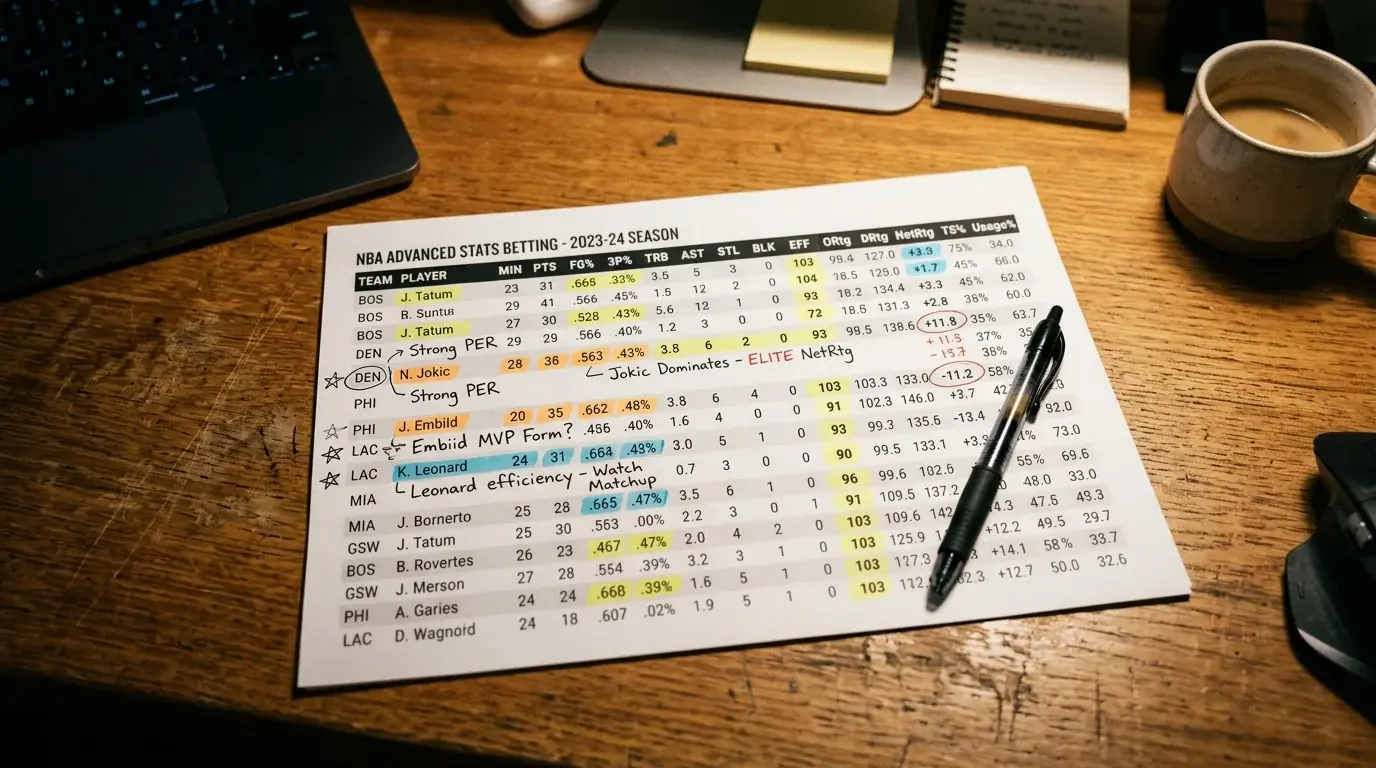
I spent two full seasons betting NBA with nothing but box scores and gut instinct. Points per game, rebounds, assists — the numbers on the back of a trading card. My results were mediocre: slightly above breakeven in good months, slightly below in bad ones. The shift happened when I started feeding advanced metrics into my analysis. Not because the numbers are magic, but because they strip away the noise that basic stats carry. Basketball is forecast to post the fastest compound annual growth rate in US sports betting through 2030, and the bettors capturing the lion’s share of that expanding market are the ones treating data as their primary tool.
Apply advanced stats to NBA home court advantage analysis.
Effective Field Goal Percentage
Standard field goal percentage treats every made basket the same. A layup and a three-pointer both count as one make on one attempt. That is misleading, because a three-pointer is worth 50% more points than a two-pointer. Effective field goal percentage — eFG% — corrects for this by giving extra weight to made threes.
The formula is straightforward: (field goals made + 0.5 x three-pointers made) / field goal attempts. A team that shoots 45% from the field but makes a high volume of threes will have an eFG% well above 45%. A team that shoots 48% but takes almost exclusively two-pointers will have an eFG% close to 48%.
For betting, eFG% is most useful when evaluating matchups. If Team A ranks top five in eFG% and Team B ranks bottom five in opponent eFG% (meaning they allow efficient shooting), the over on the game total becomes more attractive. I cross-reference eFG% with pace data before placing any totals bet — it takes three minutes and removes the guesswork about whether a high-scoring reputation is backed by real efficiency or inflated by volume.
True Shooting Percentage
eFG% ignores free throws. True Shooting percentage — TS% — does not. It accounts for field goals, three-pointers and free throws in a single metric that measures how efficiently a player or team converts their scoring opportunities.
The calculation: points / (2 x (field goal attempts + 0.44 x free throw attempts)). The 0.44 multiplier estimates the number of possessions consumed by free throw trips, since and-one plays and technical fouls do not use a full possession.
TS% is the single best measure of individual scoring efficiency, which makes it invaluable for player prop betting. When I am evaluating a points over/under on a specific player, I check their TS% over the last 10 games against their season average. A player whose TS% has dropped significantly in recent games — say, from 60% to 52% — is likely shooting through a cold stretch. The bookmaker’s line might still reflect the season average, creating an opportunity on the under. The reverse applies when a player’s recent TS% spikes above their norm, though I treat hot streaks with more scepticism because regression is faster.
Net Rating and Offensive/Defensive Efficiency
Net rating measures the difference between a team’s offensive rating (points scored per 100 possessions) and their defensive rating (points allowed per 100 possessions). A team with a +8.5 net rating outscores opponents by 8.5 points per 100 possessions — a substantial advantage that correlates tightly with win percentage.
Among adult Gen Z in the US, 40% have a favourite NBA player — the highest figure for any sport — and that emotional connection drives betting activity that focuses on star names rather than team-level metrics. Net rating cuts through the star-name bias. A team might have the league’s most exciting player but a mediocre net rating because their defence is poor. Betting on that team as a favourite at short odds is a trap that net rating helps you avoid.
I find net rating most valuable for spread betting. The difference in net ratings between two teams provides a rough baseline for what the spread should be. If the spread offered by bookmakers deviates meaningfully from what the net rating differential suggests, I investigate further. Sometimes the bookmaker knows something I do not (injury news, schedule context). Sometimes the deviation represents genuine value. Sportradar’s Steve Byrd once described expanding NBA data feeds as a “tremendous opportunity” for operators and bettors alike — and net rating is one of the most accessible entry points into that data.
Pace and Possessions Per Game
Pace measures how many possessions a team uses per 48 minutes. It is not an efficiency metric — it is a volume metric. A team with a pace of 102 plays roughly 102 possessions per game. A team at 96 plays six fewer. That six-possession gap translates directly into scoring opportunity and is the single most important variable for totals betting.
When two high-pace teams meet, the combined possessions can push above 210 per game, inflating scoring and pushing the total upward. When two slow teams meet, the combined possessions might barely reach 190, suppressing the total. Bookmakers account for pace in their lines, but the adjustment is not always precise, particularly in early-season matchups when pace data is still based partly on the previous year’s tendencies.
A practical application I use regularly: I compare a team’s current-season pace with their pace from the same point last season. Teams that have significantly increased their pace (new coach, roster turnover, strategic shift) are often underpriced in totals markets early in the season because the bookmaker’s model has not fully captured the new tempo. By November, the market catches up. In October, the edge is real.
Applying Advanced Stats to NBA Betting Markets
The mistake I see most often is treating advanced stats as a crystal ball rather than a filter. eFG%, TS%, net rating and pace do not tell you who will win tonight’s game. They tell you whether the bookmaker’s price is reasonable given the underlying data, and they help you identify spots where the market has not fully adjusted to recent performance.
My process is simple. I pull the relevant metrics for both teams, calculate what I think the spread and total should be based on efficiency and pace, and compare my numbers to the bookmaker’s line. If the gap exceeds two points on a spread or four points on a total, I dig deeper — checking injuries, schedule context and recent form. If the gap persists after that deeper look, I have a bet. If it narrows, I pass.
Free advanced stats are available from several public sources. The NBA’s own website publishes team and player advanced metrics. Basketball Reference offers historical and current data with customisable filters. Cleaning the Glass provides possession-based data with some free access. Spending 15 minutes with them before each night’s slate will improve the quality of your analysis more than any tipster service. For specific applications of these metrics to player-level betting, my guide to NBA player props walks through the process in detail.
Explore nba betting ods for data-driven NBA insights.
The Edge That Hides in the Numbers
Advanced stats are not a shortcut to guaranteed profit. They are a language — a more precise way of describing what is happening on the court than points per game or win-loss record can provide. The punters who learn that language do not win every bet, but they make better-informed bets more consistently. Over an 82-game season and into the playoffs, that consistency is the difference between a hobby that costs money and one that earns it.
What advanced stats should I look at for NBA betting?
Start with four: effective field goal percentage (eFG%) for shooting quality, True Shooting percentage (TS%) for overall scoring efficiency, net rating for the gap between offence and defence, and pace for the number of possessions per game. Together, these four metrics give you a data-driven view of how a team plays that basic box scores cannot provide.
Where can I find free NBA advanced statistics?
The NBA’s official website publishes advanced team and player stats updated throughout the season. Basketball Reference offers deeper historical data with filters for custom date ranges. Cleaning the Glass provides possession-based metrics. The first two are entirely free; Cleaning the Glass offers limited free access alongside a subscription tier.
Created by the ”nba Betting ods” editorial team.