NBA Live Betting: In-Play Markets, Odds and Strategy
 Available in US
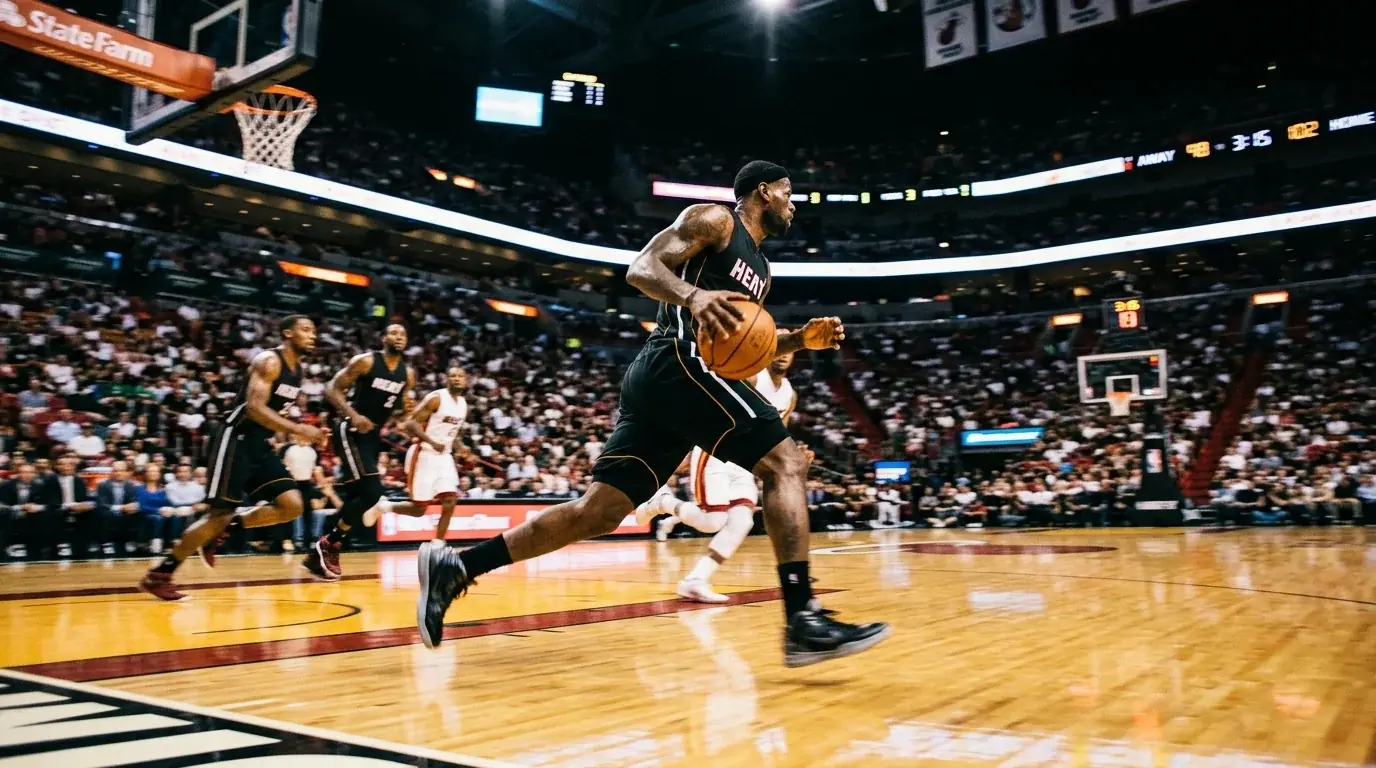
The game was Celtics-Heat, second quarter, and Miami had just gone on a 14-0 run. The live spread swung from Boston -6.5 pre-game to Miami -1.5 in the space of four minutes. I backed Boston at +1.5 because I had watched enough Celtics games to know their third-quarter response rate after first-half deficits. They outscored Miami by 18 in the third and covered comfortably. That is in-play betting at its best — using real-time information to exploit a market that overreacts to momentum.
Live betting is the fastest-growing segment of NBA wagering. In-game betting adoption is rising at 12% per year, and on mature markets live wagers now account for roughly half of all handle. The appeal is straightforward: you watch the game, you read the flow, and you act on what you see. No more placing a bet at 19:00 and waiting until 21:30 to find out the result. With live betting, you are in the market throughout — adjusting, reacting, capitalising.
For UK punters, live NBA betting comes with a unique challenge: most games tip off between 23:00 and 03:00 GMT. That late-night window limits the number of games you can actively watch and bet on, but it also thins out the recreational betting public, which can work in your favour. This guide covers the mechanics of NBA in-play markets, the specific bet types available, how live odds shift in real time, and the strategic framework I use to find edges when the clock is running.
Track in-play shifts with our NBA line movement analysis.
How NBA In-Play Betting Works
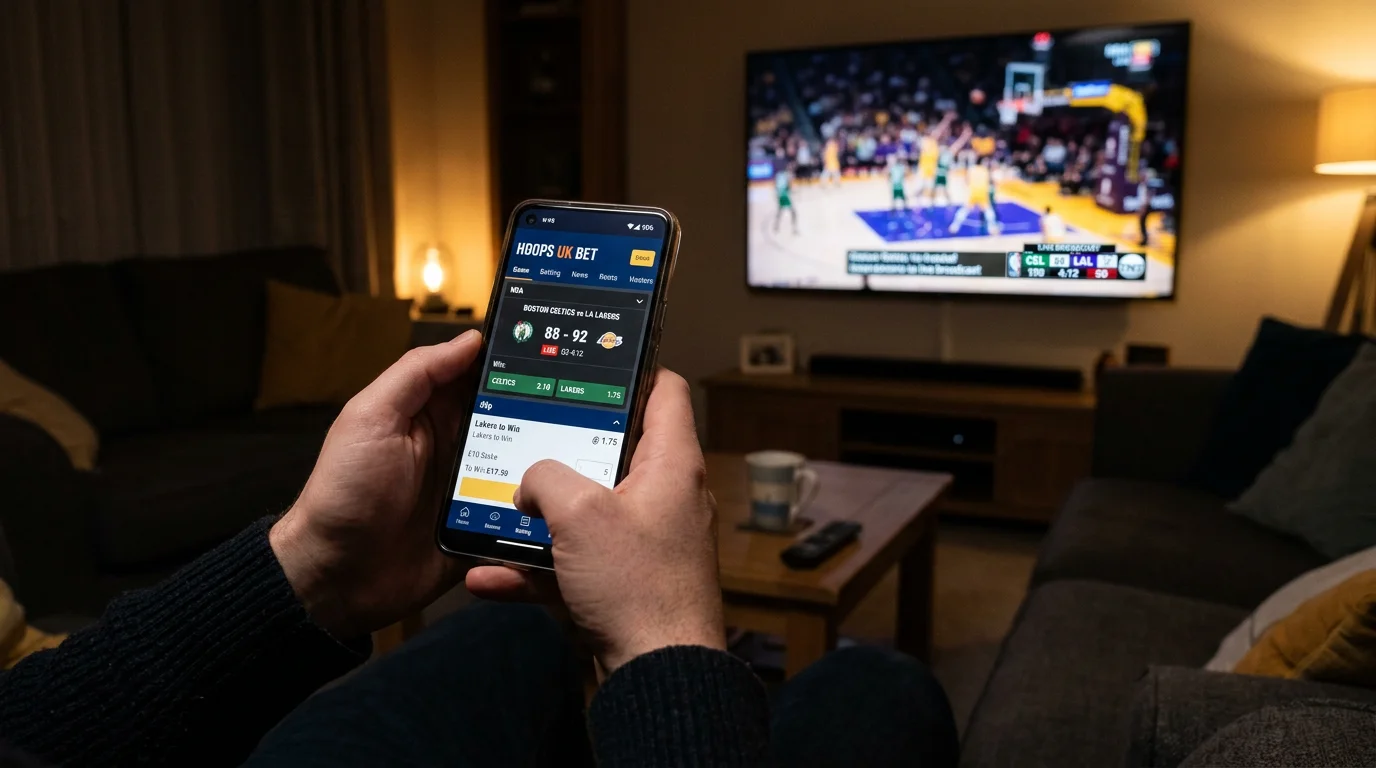
Mobile platforms now handle more than 70% of all basketball betting volume, and live betting is the primary reason. The in-play engine works like this: a data feed from the arena delivers play-by-play information to the bookmaker’s trading desk — or more accurately, to an algorithm that processes it. The algorithm recalculates odds after every possession, factoring in the score, time remaining, team quality, pace and dozens of other variables. Those recalculated odds are pushed to your screen within seconds.
When you place a live bet, you are accepting the odds displayed at the moment you click. But because NBA games move fast — an average possession lasts about 14 seconds — the odds can change between the moment you see them and the moment your bet is confirmed. Most UK sportsbooks handle this with an “accept odds changes” toggle or a brief delay during which the bookmaker confirms the price is still available. If the odds have moved significantly, your bet may be rejected or offered at the new price.
The in-play market opens at tip-off and remains active through every quarter, halftime and overtime period. Some bookmakers suspend the market during free throws, timeouts or reviews; others keep it open but adjust the odds to reflect the situation. The practical effect is that you cannot always bet exactly when you want to. Recognising when the market is likely to be suspended — end-of-quarter buzzer situations, intentional foul sequences, video reviews — helps you time your entries to avoid frustration.
One structural detail worth noting: live odds carry a wider margin than pre-game odds. The bookmaker’s overround on in-play NBA markets is typically 6-10%, compared to 4-6% pre-game. That wider margin is the price you pay for the privilege of real-time information. It means your edge needs to be larger in-play to overcome the house take, which is why live betting rewards discipline and punishes impulse.
In-Play Markets Available at UK Bookmakers
The menu of live NBA markets at UK bookmakers has expanded considerably in recent years. Where you once had a live moneyline and a live spread, you now find a full suite of in-play options that mirrors — and in some cases exceeds — the pre-game offering. Here is what is available during a typical game.
Quarter and Half Markets
Quarter and half markets let you bet on the outcome of individual periods rather than the full game. First-quarter spread, second-quarter totals, first-half moneyline, second-half spread — each is priced independently based on the live game state and historical period-by-period performance data.
These markets are particularly useful when your read on the game applies to a specific window rather than the full 48 minutes. If you think a team will start strong because their opponent’s bench rotation is weak in the second unit’s first shift, a first-quarter or first-half bet isolates that edge without exposing you to the randomness of the final two quarters.
Second-half markets deserve special attention. They open during halftime and price in everything that happened in the first half. A team trailing by 15 at the break might be +1.5 on the second-half spread — meaning the bookmaker expects them to play roughly even in the second half despite the lopsided first. If your analysis of the first-half flow tells you the trailing team was actually the better side — maybe they dominated possession but missed open shots — the second-half spread can be a sharp entry point.
Next-Basket, Next-Scorer and Micro-Markets
Micro-markets are the newest addition to the live NBA menu, and they are also the most addictive. Next-basket bets ask you to predict the outcome of the very next scoring play — will it be a two-pointer, a three-pointer or free throws? You can also bet on the next scorer, typically from a list of four or five players currently on the court.
The appeal is instant gratification. A next-basket bet settles in seconds, not hours. You watch a possession unfold, your bet resolves, and you are immediately offered another. The danger should be obvious: this format is designed to encourage volume. The margins on micro-markets are significantly wider than on standard in-play spreads — often 12-15% overround — which means you need to be selective rather than treating them as entertainment.
Where micro-markets do offer genuine value is in specific game situations. During a dead-ball sequence after a timeout, you know which five players are on the court, and you know the offensive set is likely to be a designed play. If the team’s primary action out of timeouts consistently targets a particular player, the next-scorer market may underprice that player relative to his teammates. Similarly, in end-of-quarter situations where teams heave three-pointers, the next-basket “three-pointer” option is often underpriced because the algorithm anchors on overall shot distribution rather than situational behaviour.
How NBA Live Odds Shift in Real Time
I have seen a live spread move by eight points in under two minutes. It happened during a Bucks-Nets game where Giannis Antetokounmpo rolled his ankle, walked to the locker room, and the spread immediately jumped from Milwaukee -4 to Brooklyn -4. The injury was later reported as minor, Giannis returned, and the spread reverted. If you had been watching the broadcast closely, you would have noticed he walked off under his own power, with no limp. The market panicked; an informed bettor could have acted.
NBA live odds respond to three primary inputs: score changes, time remaining and information shocks. Score changes are continuous and expected — every basket nudges the spread and total by a fraction. Time remaining acts as a compression force: the same six-point lead that barely moves the spread in the first quarter can swing it dramatically with three minutes left. Information shocks — injuries, ejections, foul trouble — create the largest and most sudden movements, because they alter the fundamental quality of one side.
The algorithms that set live odds are sophisticated but not omniscient. They excel at processing quantitative inputs like score, pace and shooting percentages. They are weaker at interpreting qualitative factors: a coaching adjustment, a shift in defensive scheme, a team’s body language after a contentious call. Adam Silver has spoken about collaboration with betting companies, focusing on “putting in place additional controls to prevent manipulation” — but from a bettor’s perspective, the more relevant point is that the algorithm’s blind spots are your opportunity.
A practical pattern I track is what I call “false momentum.” A team goes on a 10-0 run, the live odds shift heavily in their favour, and the trailing team calls timeout. In many cases, the run was fuelled by transition baskets off turnovers rather than sustained offensive dominance. The timeout stops the bleeding, the game reverts to half-court play, and the trailing team’s underlying quality reasserts itself. The live odds during that 10-0 run have overcorrected, and the timeout is your cue to bet against the momentum.
Conversely, “real momentum” looks different. It tends to involve defensive stops followed by quality half-court offence, not fast-break points off sloppy turnovers. If the run is built on repeatable actions — a mismatch being exploited, a defensive scheme that the opposition cannot solve — the odds movement is justified and you should stay away.
In-Play Strategy: Reading Momentum and Pace
Every NBA game tells you a story in the first quarter that the odds have not fully priced. The challenge is learning to read it in real time, under pressure, with money on the line. Here is the framework I use — not a magic formula, but a structured way to process what I am seeing.
First, pace. Before the game, I note the expected pace based on each team’s season average. If the first quarter plays significantly faster or slower than expected, that tells me something about the game plan. A team deliberately slowing the pace against a faster opponent is trying to limit possessions and keep the game close. If they succeed for a quarter or two, the live odds may not have adjusted enough — the algorithm expects pace to revert to the mean, but a coaching decision to control tempo can persist for an entire game.
Second, rotation patterns. NBA coaches have predictable substitution habits. Most starters sit at about the five-minute mark of the first quarter and return near the start of the second. That bench-unit window — roughly minutes five through twelve of game time — is when talent gaps between teams are most exposed. A team with a deep bench will often extend or erase a lead during this window, and the live odds do not always account for the quality disparity between the units currently on the court.
Third, three-point variance. NBA teams attempt roughly 35 three-pointers per game, and league-average shooting is about 36%. In a single quarter, a team might go 5-for-7 or 1-for-8 from deep. Both outcomes are well within normal variance, but the live odds react as if the hot or cold shooting reflects a persistent change. I watch for games where one team has shot significantly above or below their season average from three in the first half. Regression is not guaranteed in the second half, but the odds have already priced in the anomaly as if it will continue, which creates value on the other side.
The demographic angle matters here too. Among 18-to-24-year-olds in the UK, 76% use their phones for betting, and that cohort gravitates toward live markets because the format mirrors the instant feedback loop of social media. The practical effect is that late-night NBA live markets — when fewer sharp bettors are active but plenty of younger recreational punters are still scrolling — can produce softer lines than you would find during peak Premier League hours. It is not a guaranteed edge, but it is a structural feature worth understanding.
Fourth, foul situation. Foul trouble is one of the most underpriced factors in live NBA markets. When a team’s best player picks up his third foul in the first half, the coach typically benches him until after halftime. That player’s absence for 8-12 minutes of game time has a measurable impact on the team’s offensive and defensive efficiency, but the live odds often make only a modest adjustment. If you are watching the game and you see a key player head to the bench with foul trouble, check the live spread immediately — the adjustment is frequently too small.
Explore nba betting ods for real-time NBA markets.
Common In-Play Mistakes and How to Avoid Them
I once placed four live bets in a single quarter of a Suns-Lakers game. I won two and lost two, but the cumulative margin cost — the overround on each bet — meant I finished the quarter down despite a 50% strike rate. That experience taught me the most important rule of in-play betting: volume is your enemy.
The first mistake is chasing. You lose a live bet, and the immediate impulse is to place another to recover. The game is still on, the odds are still moving, and there is always another opportunity — or so it feels. In reality, each additional bet adds another layer of margin. If you would not have placed the second bet without the first loss, you should not be placing it at all. I set a strict limit of two live bets per game. Some games I place zero. The constraint is more valuable than any individual wager.
The second mistake is betting on familiar names rather than live game state. Just because LeBron James is on the court does not mean his team is the right live bet. A star player in foul trouble, coming off a back-to-back, or visibly fatigued in the fourth quarter is a different proposition from the version of him the brand represents. Live betting rewards observation, not reputation. Watch what is happening now, not what usually happens.
The third mistake is ignoring the clock. A ten-point lead with ten minutes to play is fundamentally different from a ten-point lead with two minutes to play. The live odds reflect this, but many bettors do not. I have watched people back a team at terrible odds because “they are winning by ten” without considering that the spread has already adjusted. The implied probability of a ten-point lead holding up with two minutes remaining is above 95% — the odds you are getting reflect that, and there is no value left.
The fourth, and most subtle, mistake is anchoring to the pre-game line. You had the Knicks at -3 in your pre-game analysis, the game tips off, and they fall behind by six in the first quarter. The live line now has them at +2.5, and you think: “I liked them at -3, so +2.5 is a steal.” Maybe. But the first quarter also told you something about why they are losing, and if that information — a defensive scheme they cannot crack, an injury to a rotation player, an unexpected matchup problem — is persistent, the pre-game analysis is outdated. Every live bet should be evaluated on current information, not on the ghost of a number you circled before tip-off.
Mobile Live Betting: Latency, Apps and UK Options
Your phone is both the best and worst tool for live NBA betting. Best, because it puts the market in your hand while you watch the game. Worst, because a laggy app or a slow connection can cost you the odds you wanted — and in live betting, the difference between the price you saw and the price you got is often the difference between value and overpayment.
Latency is the technical term for the delay between the live event and the odds update on your screen. In practice, the broadcast feed you are watching on television or a streaming service runs 5-15 seconds behind the arena. The bookmaker’s data feed is closer to real time, typically 1-3 seconds behind. That gap means the bookmaker knows the result of a play before you see it on screen, and the odds have already adjusted by the time you react to what you just watched. You are always trading on slightly stale information, and accepting that reality is essential to managing your expectations.
Practically, there are a few things you can do to reduce the disadvantage. Use the fastest available stream — a cable or satellite broadcast has less delay than most internet streams. Close unnecessary apps to keep your betting app responsive. Pre-load the game’s live market before tip-off so you are not navigating menus when the action starts. And if your bet is rejected because the odds moved, resist the temptation to accept the new, worse price automatically. Pause, reassess, and only proceed if the revised odds still represent value.
For UK punters specifically, the late-night timing of NBA games means you are often betting on mobile from the sofa or in bed. The ergonomics matter: a well-designed app with large bet-placement buttons and clear odds display reduces the chance of a costly mis-tap. Most major UK-licensed bookmakers have invested heavily in their live betting interfaces, but the quality varies. Before the season, I spend time testing the live NBA experience on two or three apps during pre-season games — low-stakes experiments to find which platform offers the smoothest in-play workflow for basketball specifically. The schedule dynamics of back-to-back games make platform reliability even more important, because those compressed fixtures produce the most volatile live odds.
Frequently Asked Questions
How does live NBA betting work with UK bookmakers?
Live NBA betting opens at tip-off and stays active through every quarter, halftime and overtime. A real-time data feed updates odds after each possession based on score, time remaining and game state. You place bets at the displayed odds, though prices may change between clicking and confirmation due to the fast pace of play. Most UK-licensed bookmakers offer live spreads, moneylines, totals, quarter and half markets, and micro-markets like next scorer.
Can I cash out a live NBA bet mid-game?
Most major UK bookmakers offer partial or full cash-out on live NBA bets, though availability depends on the market and game situation. Cash-out values fluctuate with the live odds — if your bet is winning, the cash-out offer rises; if it is losing, the offer drops. The bookmaker applies a margin to the cash-out price, so you will typically receive less than the theoretical fair value. Cash-out is a risk-management tool, not a profit strategy.
Is there a delay on live NBA odds at UK sportsbooks?
Yes. The bookmaker’s data feed runs 1-3 seconds behind real-time arena action, and your broadcast is typically 5-15 seconds behind that. This means odds adjust before you see the play on screen. Some bookmakers also impose a brief processing delay on live bet acceptance to verify the current price. The practical effect is that you are always trading on slightly delayed information, which is built into the structure of live betting.
Which quarters tend to offer the most profitable live betting opportunities?
The transition between first and second quarters — when starters rotate out for bench units — often creates the sharpest value, because the live algorithm adjusts slowly to the quality difference between lineups. Second-half markets at halftime are also strong candidates, especially when a first-half blowout was driven by unsustainable three-point shooting or turnover rates. Fourth-quarter markets carry the highest variance and widest margins, making them the hardest to profit from consistently.
Published by the nba Betting ods team.